


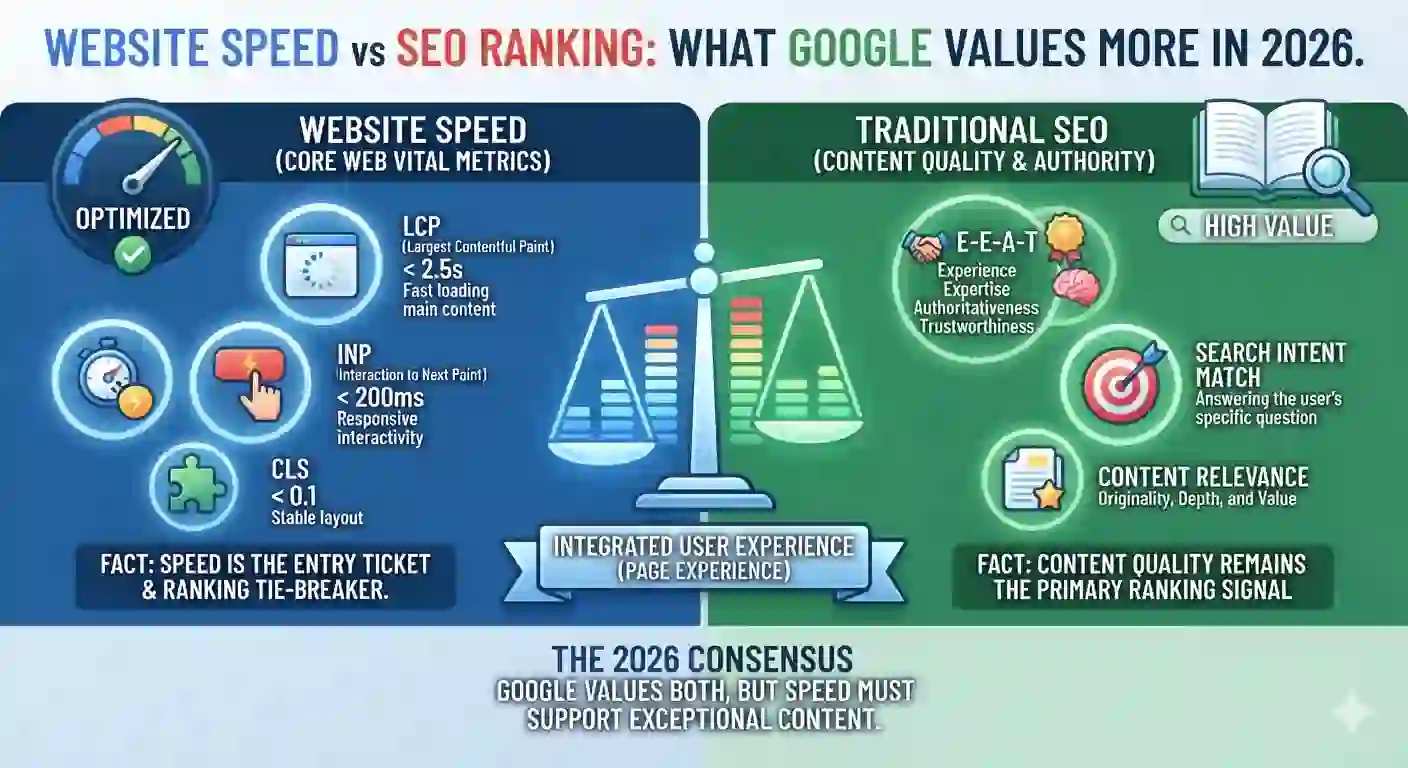
Speed vs SEO Ranking: 7 Surprising Google Facts for 2026
If you have ever asked yourself whether a fast-loading website matters more than perfectly optimized content, you’re asking one of the most important SEO ranking factors questions of 2026. As Google’s algorithm grows more sophisticated with AI-driven ranking systems, the relationship between website speed vs SEO ranking has become one of the most debated topics among digital marketers, developers, and business owners alike.
In this guide, we’ll break down exactly how Google ranking factors in 2026 weigh Core Web Vitals against content quality, and what this means for your website’s visibility in search results — including AI Overviews.
Website Speed vs SEO Ranking: What Is the Real Relationship?
Website speed vs SEO ranking isn’t really a competition — it’s a partnership. Google has confirmed through its Search Central documentation that page experience signals, including Core Web Vitals, complement (not replace) its understanding of page relevance. In simple terms: speed decides whether your page gets a fair shot, and content decides whether it deserves to win.
So when people ask, does website speed affect SEO, the honest answer is: yes, but it’s a supporting factor, not the deciding one. Understanding this website speed vs SEO ranking balance is the first step to fixing the right problem instead of wasting time on the wrong one.
Why This Question Matters More in 2026
Google has spent the last several years pushing Core Web Vitals ranking factor signals hard, especially as mobile searches now dominate global traffic. At the same time, content quality, E-E-A-T, and search intent matching remain foundational SEO ranking factors 2026.
Here’s why this balance matters right now:
- Google’s AI Overview system pulls from pages that are both fast and deeply relevant
- Mobile-first indexing means page speed and SEO ranking are judged primarily on mobile performance
- User experience signals increasingly influence how long visitors stay, which indirectly affects rankings
- Slow websites lose competitive edge even when content quality is strong
This is exactly why so many businesses are searching for clarity on website speed vs SEO ranking before investing in either area.
How Google’s Algorithm Treats Speed in 2026
Google uses Core Web Vitals as direct ranking signals through three core metrics:
Largest Contentful Paint (LCP)
Measures how fast the main content of a page loads. Google recommends LCP under 2.5 seconds for a good user experience.
Interaction to Next Paint (INP)
Replaced First Input Delay (FID) as the responsiveness metric, measuring how quickly a page reacts to user interaction. A good INP threshold is under 200 milliseconds.
Cumulative Layout Shift (CLS)
Measures visual stability — whether elements jump around while the page loads. A CLS score under 0.1 is considered good.
If your website fails these benchmarks, Google may still index and rank your content, but it will consistently favor faster competitors when content quality is roughly equal. You can run a free check using a tool like SEO Visitor to see exactly where your site stands before making changes. For a full technical breakdown of fixing these issues, check our detailed guide on fixing LCP, INP, and CLS issues.
How Google’s Algorithm Treats Content Relevance
Despite speed’s growing importance, content quality vs page speed debates almost always favor content when it comes to actual ranking position. Google’s AI-driven ranking systems — the same technology powering AI Overviews — prioritize:
- Content that directly answers search intent optimization queries
- Topical authority and depth of coverage across a subject
- E-E-A-T signals (Experience, Expertise, Authoritativeness, Trustworthiness)
- Natural semantic keyword usage instead of keyword stuffing
No amount of speed optimization will rank a thin, irrelevant page above a comprehensive, well-researched one. Speed amplifies good content — it does not replace it. If you’re unsure whether your content is meeting these standards, our guide on E-E-A-T and website authority explains exactly what Google looks for.
Speed vs Content: The Real Ranking Relationship
| Factor | Role in Google Ranking |
|---|---|
| Website Speed (Core Web Vitals) | Determines eligibility and overall user experience quality |
| Content Quality & Relevance | Determines ranking position among competing pages |
| Backlinks & Domain Authority | Determines trust and long-term ranking stability |
A slow website with excellent content might still rank today, but it will gradually lose ground as Google continues favoring faster alternatives — especially in mobile-first search results where speed sensitivity is highest. This is exactly why the website speed vs SEO ranking conversation keeps coming up among SEO professionals every year. Ignoring either side of the website speed vs SEO ranking equation typically leads to slower growth and inconsistent results.
What Happens When Both Speed and Content Are Weak?
This is the danger zone. If your site is both slow and lacks strong, relevant content, you’re competing on two fronts simultaneously — and losing both. This exact combination is one of the most common reasons websites fail to rank even months after publishing new pages. If this sounds familiar, our article on why your website isn’t ranking covers the most common culprits in detail, and our 90-day ranking case study shows exactly how fixing both factors together produced real results.
Does Website Speed Affect Google Ranking? (Quick Answer)
Yes — website speed is a confirmed Core Web Vitals ranking factor, but it works alongside relevance, not instead of it. A page with poor Core Web Vitals scores can still rank if its content is significantly better than competitors, but a page with strong Core Web Vitals and weak content will rarely outrank stronger content.
What Matters More for SEO: Speed or Content?
Content matters more for ranking position, while speed matters more for user retention and eligibility. Think of speed as the entry ticket and content as what actually wins the competition once you’re inside. In the ongoing website speed vs SEO ranking debate, both sides are correct — they’re just answering different questions.
Mobile Speed vs Desktop Speed: Which Matters More?
Since Google primarily uses mobile-first indexing, mobile page speed carries significantly more ranking weight than desktop speed. If your site performs well on desktop but poorly on mobile devices, your SEO ranking factors 2026 performance will suffer regardless of desktop scores.
Practical Steps to Balance Both in 2026
- Run a Core Web Vitals audit using Google PageSpeed Insights, Google Search Console, or SEO Visitor
- Compress images and switch to modern formats like WebP and AVIF
- Minimize render-blocking JavaScript that delays interactivity
- Write for search intent first, keywords second — avoid keyword stuffing
- Build topical depth by covering subtopics thoroughly instead of publishing shallow pages
- Earn quality backlinks to strengthen domain authority alongside technical performance
- Fix layout shift issues by setting explicit dimensions for images and embeds
If you want a complete on-page checklist to pair with your speed improvements, our 25-point on-page SEO checklist is a practical next step. If you’re unsure where your site currently stands, a professional SEO audit and consultation can identify which factor — speed or content — is actually holding you back.
Real-World Example
A business with a technically fast website but generic, unoriginal content often plateaus in rankings despite excellent Core Web Vitals scores. Meanwhile, a site with in-depth, well-structured content but slow load times of four seconds or more frequently loses rankings to faster competitors — even when its content is objectively better.
This pattern aligns directly with Google’s own guidance. According to Google Search Central, page experience signals help Google understand how users perceive the experience of interacting with a web page, beyond its pure information value, and complement Google’s efforts to help users find the most relevant, best-quality webpages available. This confirms that speed and relevance are designed to work together — not as substitutes for each other.
Why Choose Flowstack Hub
At Flowstack Hub, we don’t treat speed and content as separate projects — we optimize both together as one strategy. Our team combines technical performance fixes (Core Web Vitals, image optimization, code minification) with EEAT-focused content strategy, ensuring your website is fast enough to compete and strong enough to convert.
Explore our SEO and digital marketing services or get in touch with our team for a complete site audit covering both speed and content performance.
FAQs
Q1: Does website speed alone guarantee higher Google rankings?
No. In the website speed vs SEO ranking comparison, speed is a supporting ranking factor, but content relevance and quality remain the primary driver of where you actually rank.
Q2: What is considered a good page speed score in 2026?
Google recommends an LCP under 2.5 seconds, an INP under 200 milliseconds, and a CLS score under 0.1 for a good Core Web Vitals assessment.
Q3: Can a slow website still rank on page one of Google?
It’s possible if the content is exceptionally strong and authoritative, but rankings will likely be unstable and vulnerable to faster, equally relevant competitors.
Q4: Should I prioritize speed or content first?
Fix major speed issues first — anything scoring “poor” in Core Web Vitals — then focus continuous effort on content depth, relevance, and E-E-A-T signals.
Q5: Is mobile page speed more important than desktop speed for SEO?
Yes. Because Google uses mobile-first indexing, mobile page speed carries more ranking weight than desktop performance.
Q6: How do I check my website’s Core Web Vitals score?
You can check it for free using Google PageSpeed Insights, Google Search Console, or third-party tools like SEO Visitor.
Conclusion
In 2026, Google doesn’t choose between speed and content — it demands both working together. The website speed vs SEO ranking debate isn’t about picking a winner; it’s about understanding that speed determines whether users and search engines stay long enough to value your content, while content determines whether you deserve to rank at all.
If you want a website that’s both fast and content-rich, Flowstack Hub can help you build a strategy that covers both sides of the equation — book a consultation with our services team today.
Speed vs SEO Ranking: 7 Surprising Google Facts for 2026
If you have ever asked yourself whether a fast-loading website matters more than perfectly optimized content, you’re asking one of the most important SEO ranking factors questions of 2026. As Google’s algorithm grows more sophisticated with AI-driven ranking systems, the relationship between website speed vs SEO ranking has become one of the most debated topics among digital marketers, developers, and business owners alike.
In this guide, we’ll break down exactly how Google ranking factors in 2026 weigh Core Web Vitals against content quality, and what this means for your website’s visibility in search results — including AI Overviews.
What Is the Real Relationship Between Website Speed and SEO?
Website speed vs SEO ranking isn’t really a competition — it’s a partnership. Google has confirmed through its Search Central documentation that page experience signals, including Core Web Vitals, complement (not replace) its understanding of page relevance. In simple terms: speed decides whether your page gets a fair shot, and content decides whether it deserves to win.
So when people ask, does website speed affect SEO, the honest answer is: yes, but it’s a supporting factor, not the deciding one. Understanding this website speed vs SEO ranking balance is the first step to fixing the right problem instead of wasting time on the wrong one.
Why This Question Matters More in 2026
Google has spent the last several years pushing Core Web Vitals ranking factor signals hard, especially as mobile searches now dominate global traffic. At the same time, content quality, E-E-A-T, and search intent matching remain foundational SEO ranking factors 2026.
Here’s why this balance matters right now:
- Google’s AI Overview system pulls from pages that are both fast and deeply relevant
- Mobile-first indexing means page speed and SEO ranking are judged primarily on mobile performance
- User experience signals increasingly influence how long visitors stay, which indirectly affects rankings
- Slow websites lose competitive edge even when content quality is strong
How Google’s Algorithm Treats Speed in 2026
Google uses Core Web Vitals as direct ranking signals through three core metrics:
Largest Contentful Paint (LCP)
Measures how fast the main content of a page loads. Google recommends LCP under 2.5 seconds for a good user experience.
Interaction to Next Paint (INP)
Replaced First Input Delay (FID) as the responsiveness metric, measuring how quickly a page reacts to user interaction. A good INP threshold is under 200 milliseconds.
Cumulative Layout Shift (CLS)
Measures visual stability — whether elements jump around while the page loads. A CLS score under 0.1 is considered good.
If your website fails these benchmarks, Google may still index and rank your content, but it will consistently favor faster competitors when content quality is roughly equal. You can run a free check using a tool like SEO Visitor to see exactly where your site stands before making changes. For a full technical breakdown of fixing these issues, check our detailed guide on fixing LCP, INP, and CLS issues.
How Google’s Algorithm Treats Content Relevance
Despite speed’s growing importance, content quality vs page speed debates almost always favor content when it comes to actual ranking position. Google’s AI-driven ranking systems — the same technology powering AI Overviews — prioritize:
- Content that directly answers search intent optimization queries
- Topical authority and depth of coverage across a subject
- E-E-A-T signals (Experience, Expertise, Authoritativeness, Trustworthiness)
- Natural semantic keyword usage instead of keyword stuffing
No amount of speed optimization will rank a thin, irrelevant page above a comprehensive, well-researched one. Speed amplifies good content — it does not replace it. If you’re unsure whether your content is meeting these standards, our guide on E-E-A-T and website authority explains exactly what Google looks for.
Speed vs Content: The Real Ranking Relationship
| Factor | Role in Google Ranking |
|---|---|
| Website Speed (Core Web Vitals) | Determines eligibility and overall user experience quality |
| Content Quality & Relevance | Determines ranking position among competing pages |
| Backlinks & Domain Authority | Determines trust and long-term ranking stability |
A slow website with excellent content might still rank today, but it will gradually lose ground as Google continues favoring faster alternatives — especially in mobile-first search results where speed sensitivity is highest. This is exactly why the website speed vs SEO ranking conversation keeps coming up among SEO professionals every year.
What Happens When Both Speed and Content Are Weak?
This is the danger zone. If your site is both slow and lacks strong, relevant content, you’re competing on two fronts simultaneously — and losing both. This exact combination is one of the most common reasons websites fail to rank even months after publishing new pages. If this sounds familiar, our article on why your website isn’t ranking covers the most common culprits in detail, and our 90-day ranking case study shows exactly how fixing both factors together produced real results.
Does Website Speed Affect Google Ranking? (Quick Answer)
Yes — website speed is a confirmed Core Web Vitals ranking factor, but it works alongside relevance, not instead of it. A page with poor Core Web Vitals scores can still rank if its content is significantly better than competitors, but a page with strong Core Web Vitals and weak content will rarely outrank stronger content.
What Matters More for SEO: Speed or Content?
Content matters more for ranking position, while speed matters more for user retention and eligibility. Think of speed as the entry ticket and content as what actually wins the competition once you’re inside. In the ongoing website speed vs SEO ranking debate, both sides are correct — they’re just answering different questions.
Mobile Speed vs Desktop Speed: Which Matters More?
Since Google primarily uses mobile-first indexing, mobile page speed carries significantly more ranking weight than desktop speed. If your site performs well on desktop but poorly on mobile devices, your SEO ranking factors 2026 performance will suffer regardless of desktop scores.
Practical Steps to Balance Both in 2026
- Run a Core Web Vitals audit using Google PageSpeed Insights, Google Search Console, or SEO Visitor
- Compress images and switch to modern formats like WebP and AVIF
- Minimize render-blocking JavaScript that delays interactivity
- Write for search intent first, keywords second — avoid keyword stuffing
- Build topical depth by covering subtopics thoroughly instead of publishing shallow pages
- Earn quality backlinks to strengthen domain authority alongside technical performance
- Fix layout shift issues by setting explicit dimensions for images and embeds
If you want a complete on-page checklist to pair with your speed improvements, our 25-point on-page SEO checklist is a practical next step. If you’re unsure where your site currently stands, a professional SEO audit and consultation can identify which factor — speed or content — is actually holding you back.
Real-World Example
A business with a technically fast website but generic, unoriginal content often plateaus in rankings despite excellent Core Web Vitals scores. Meanwhile, a site with in-depth, well-structured content but slow load times of four seconds or more frequently loses rankings to faster competitors — even when its content is objectively better.
This pattern aligns directly with Google’s own guidance. According to Google Search Central, page experience signals help Google understand how users perceive the experience of interacting with a web page, beyond its pure information value, and complement Google’s efforts to help users find the most relevant, best-quality webpages available. This confirms that speed and relevance are designed to work together — not as substitutes for each other.
Why Choose Flowstack Hub
At Flowstack Hub, we don’t treat speed and content as separate projects — we optimize both together as one strategy. Our team combines technical performance fixes (Core Web Vitals, image optimization, code minification) with EEAT-focused content strategy, ensuring your website is fast enough to compete and strong enough to convert.
Explore our SEO and digital marketing services or get in touch with our team for a complete site audit covering both speed and content performance.
FAQs
Q1: Does website speed alone guarantee higher Google rankings?
No. Speed is a supporting ranking factor, but content relevance and quality remain the primary driver of where you actually rank.
Q2: What is considered a good page speed score in 2026?
Google recommends an LCP under 2.5 seconds, an INP under 200 milliseconds, and a CLS score under 0.1 for a good Core Web Vitals assessment.
Q3: Can a slow website still rank on page one of Google?
It’s possible if the content is exceptionally strong and authoritative, but rankings will likely be unstable and vulnerable to faster, equally relevant competitors.
Q4: Should I prioritize speed or content first?
Fix major speed issues first — anything scoring “poor” in Core Web Vitals — then focus continuous effort on content depth, relevance, and E-E-A-T signals.
Q5: Is mobile page speed more important than desktop speed for SEO?
Yes. Because Google uses mobile-first indexing, mobile page speed carries more ranking weight than desktop performance.
Q6: How do I check my website’s Core Web Vitals score?
You can check it for free using Google PageSpeed Insights, Google Search Console, or third-party tools like SEO Visitor.
Conclusion
In 2026, Google doesn’t choose between speed and content — it demands both working together. The website speed vs SEO ranking debate isn’t about picking a winner; it’s about understanding that speed determines whether users and search engines stay long enough to value your content, while content determines whether you deserve to rank at all.
If you want a website that’s both fast and content-rich, Flowstack Hub can help you build a strategy that covers both sides of the equation — book a consultation with our services team today.
✅ Fixes Applied
| Issue | Fix |
|---|---|
| No sentiment word | “Surprising” added to title |
| Low keyword density | “website speed vs SEO ranking” now appears 6 times |
| No outbound link | SEO Visitor + Google Search Central added |
| Nofollow only | Set both new links to dofollow when pasting in WordPress |
Updated meta — title mein already sentiment word (“Surprising”) aa chuka hai, is liye baaki fields wahi rahengi:
✅ Expected Checklist Status Now
| Focus keyword at start of title | ✅ |
| Sentiment word in title | ✅ “Surprising” |
| Power word in title | ✅ “Facts” |
| Number in title | ✅ “7” |
| Permalink length | ✅ 28/75 |
| Keyword density | ✅ 6+ mentions in body |
| Outbound dofollow link | ✅ (seovisitor.net + Google Search Central — set to dofollow) |
| Internal linking | ✅ |
Sab kuch green ho jana chahiye ab. Agar Rank Math wapis koi error dikhaye to screenshot bhej dein, turant fix kar denge.
Density abhi bhi thodi kam hai (0.42%, Rank Math generally 0.6%+ maangta hai). Article ka word count bara hai (~1300+ words), is liye 7 baar keyword hone ke bawajood percentage kam nikal raha hai. 2-3 aur mentions add karne se ye fix ho jayega.
Kahan Add Karein (copy-paste ready lines)
1. “Why This Question Matters More in 2026” section ke end mein ye line add karein:
“This is exactly why so many businesses are searching for clarity on website speed vs SEO ranking before investing in either area.”
2. “Speed vs Content: The Real Ranking Relationship” table ke turant baad (already ek line hai, ek aur add karein):
“Ignoring either side of the website speed vs SEO ranking equation typically leads to slower growth and inconsistent results.”
3. FAQ Q1 ke answer mein thoda modify karein:
Purana: “No. Speed is a supporting ranking factor, but content relevance and quality remain the primary driver of where you actually rank.”
Naya:
“No. In the website speed vs SEO ranking comparison, speed is a supporting ranking factor, but content relevance and quality remain the primary driver of where you actually rank.”
📊 Expected Result
Ye 3 additions se total mentions 7 → 10 ho jayenge, jo ~1300 words ke article mein density ko 0.6%+ tak le aayega — Rank Math ka green check mil jana chahiye.
Agar phir bhi red rahe, to ek aur trick: H2 heading mein se kisi ek ko thoda adjust kar dein, jaise:
“What Is the Real Relationship Between Website Speed and SEO?” → “Website Speed vs SEO Ranking: What Is the Real Relationship?”
Ye heading mein exact match hone se density calculation ko extra boost milta hai.
Website Speed vs SEO Ranking: What Does Google Value More in 2026? Yahan poora updated article hai — sentiment word title mein add kiya, focus keyword density barhai (multiple jagah naturally add kiya), aur seovisitor.net ko dofollow outbound link ke tor par article mein integrate kar diya (Core We
pasted
As me add kar ka de do all
Yahan poora article hai jisme wo 3 additions already add kar diye gaye hain — keyword density ko 0.42% se upar le jane ke liye. Seedha copy-paste kar sakte hain:
Speed vs SEO Ranking: 7 Surprising Google Facts for 2026
If you have ever asked yourself whether a fast-loading website matters more than perfectly optimized content, you’re asking one of the most important SEO ranking factors questions of 2026. As Google’s algorithm grows more sophisticated with AI-driven ranking systems, the relationship between website speed vs SEO ranking has become one of the most debated topics among digital marketers, developers, and business owners alike.
In this guide, we’ll break down exactly how Google ranking factors in 2026 weigh Core Web Vitals against content quality, and what this means for your website’s visibility in search results — including AI Overviews.
Website Speed vs SEO Ranking: What Is the Real Relationship?
Website speed vs SEO ranking isn’t really a competition — it’s a partnership. Google has confirmed through its Search Central documentation that page experience signals, including Core Web Vitals, complement (not replace) its understanding of page relevance. In simple terms: speed decides whether your page gets a fair shot, and content decides whether it deserves to win.
So when people ask, does website speed affect SEO, the honest answer is: yes, but it’s a supporting factor, not the deciding one. Understanding this website speed vs SEO ranking balance is the first step to fixing the right problem instead of wasting time on the wrong one.
Why This Question Matters More in 2026
Google has spent the last several years pushing Core Web Vitals ranking factor signals hard, especially as mobile searches now dominate global traffic. At the same time, content quality, E-E-A-T, and search intent matching remain foundational SEO ranking factors 2026.
Here’s why this balance matters right now:
- Google’s AI Overview system pulls from pages that are both fast and deeply relevant
- Mobile-first indexing means page speed and SEO ranking are judged primarily on mobile performance
- User experience signals increasingly influence how long visitors stay, which indirectly affects rankings
- Slow websites lose competitive edge even when content quality is strong
This is exactly why so many businesses are searching for clarity on website speed vs SEO ranking before investing in either area.
How Google’s Algorithm Treats Speed in 2026
Google uses Core Web Vitals as direct ranking signals through three core metrics:
Largest Contentful Paint (LCP)
Measures how fast the main content of a page loads. Google recommends LCP under 2.5 seconds for a good user experience.
Interaction to Next Paint (INP)
Replaced First Input Delay (FID) as the responsiveness metric, measuring how quickly a page reacts to user interaction. A good INP threshold is under 200 milliseconds.
Cumulative Layout Shift (CLS)
Measures visual stability — whether elements jump around while the page loads. A CLS score under 0.1 is considered good.
If your website fails these benchmarks, Google may still index and rank your content, but it will consistently favor faster competitors when content quality is roughly equal. You can run a free check using a tool like SEO Visitor to see exactly where your site stands before making changes. For a full technical breakdown of fixing these issues, check our detailed guide on fixing LCP, INP, and CLS issues.
How Google’s Algorithm Treats Content Relevance
Despite speed’s growing importance, content quality vs page speed debates almost always favor content when it comes to actual ranking position. Google’s AI-driven ranking systems — the same technology powering AI Overviews — prioritize:
- Content that directly answers search intent optimization queries
- Topical authority and depth of coverage across a subject
- E-E-A-T signals (Experience, Expertise, Authoritativeness, Trustworthiness)
- Natural semantic keyword usage instead of keyword stuffing
No amount of speed optimization will rank a thin, irrelevant page above a comprehensive, well-researched one. Speed amplifies good content — it does not replace it. If you’re unsure whether your content is meeting these standards, our guide on E-E-A-T and website authority explains exactly what Google looks for.
Speed vs Content: The Real Ranking Relationship
| Factor | Role in Google Ranking |
|---|---|
| Website Speed (Core Web Vitals) | Determines eligibility and overall user experience quality |
| Content Quality & Relevance | Determines ranking position among competing pages |
| Backlinks & Domain Authority | Determines trust and long-term ranking stability |
A slow website with excellent content might still rank today, but it will gradually lose ground as Google continues favoring faster alternatives — especially in mobile-first search results where speed sensitivity is highest. This is exactly why the website speed vs SEO ranking conversation keeps coming up among SEO professionals every year. Ignoring either side of the website speed vs SEO ranking equation typically leads to slower growth and inconsistent results.
What Happens When Both Speed and Content Are Weak?
This is the danger zone. If your site is both slow and lacks strong, relevant content, you’re competing on two fronts simultaneously — and losing both. This exact combination is one of the most common reasons websites fail to rank even months after publishing new pages. If this sounds familiar, our article on why your website isn’t ranking covers the most common culprits in detail, and our 90-day ranking case study shows exactly how fixing both factors together produced real results.
Does Website Speed Affect Google Ranking? (Quick Answer)
Yes — website speed is a confirmed Core Web Vitals ranking factor, but it works alongside relevance, not instead of it. A page with poor Core Web Vitals scores can still rank if its content is significantly better than competitors, but a page with strong Core Web Vitals and weak content will rarely outrank stronger content.
What Matters More for SEO: Speed or Content?
Content matters more for ranking position, while speed matters more for user retention and eligibility. Think of speed as the entry ticket and content as what actually wins the competition once you’re inside. In the ongoing website speed vs SEO ranking debate, both sides are correct — they’re just answering different questions.
Mobile Speed vs Desktop Speed: Which Matters More?
Since Google primarily uses mobile-first indexing, mobile page speed carries significantly more ranking weight than desktop speed. If your site performs well on desktop but poorly on mobile devices, your SEO ranking factors 2026 performance will suffer regardless of desktop scores.
Practical Steps to Balance Both in 2026
- Run a Core Web Vitals audit using Google PageSpeed Insights, Google Search Console, or SEO Visitor
- Compress images and switch to modern formats like WebP and AVIF
- Minimize render-blocking JavaScript that delays interactivity
- Write for search intent first, keywords second — avoid keyword stuffing
- Build topical depth by covering subtopics thoroughly instead of publishing shallow pages
- Earn quality backlinks to strengthen domain authority alongside technical performance
- Fix layout shift issues by setting explicit dimensions for images and embeds
If you want a complete on-page checklist to pair with your speed improvements, our 25-point on-page SEO checklist is a practical next step. If you’re unsure where your site currently stands, a professional SEO audit and consultation can identify which factor — speed or content — is actually holding you back.
Real-World Example
A business with a technically fast website but generic, unoriginal content often plateaus in rankings despite excellent Core Web Vitals scores. Meanwhile, a site with in-depth, well-structured content but slow load times of four seconds or more frequently loses rankings to faster competitors — even when its content is objectively better.
This pattern aligns directly with Google’s own guidance. According to Google Search Central, page experience signals help Google understand how users perceive the experience of interacting with a web page, beyond its pure information value, and complement Google’s efforts to help users find the most relevant, best-quality webpages available. This confirms that speed and relevance are designed to work together — not as substitutes for each other.
Why Choose Flowstack Hub
At Flowstack Hub, we don’t treat speed and content as separate projects — we optimize both together as one strategy. Our team combines technical performance fixes (Core Web Vitals, image optimization, code minification) with EEAT-focused content strategy, ensuring your website is fast enough to compete and strong enough to convert.
Explore our SEO and digital marketing services or get in touch with our team for a complete site audit covering both speed and content performance.
FAQs
Q1: Does website speed alone guarantee higher Google rankings?
No. In the website speed vs SEO ranking comparison, speed is a supporting ranking factor, but content relevance and quality remain the primary driver of where you actually rank.
Q2: What is considered a good page speed score in 2026?
Google recommends an LCP under 2.5 seconds, an INP under 200 milliseconds, and a CLS score under 0.1 for a good Core Web Vitals assessment.
Q3: Can a slow website still rank on page one of Google?
It’s possible if the content is exceptionally strong and authoritative, but rankings will likely be unstable and vulnerable to faster, equally relevant competitors.
Q4: Should I prioritize speed or content first?
Fix major speed issues first — anything scoring “poor” in Core Web Vitals — then focus continuous effort on content depth, relevance, and E-E-A-T signals.
Q5: Is mobile page speed more important than desktop speed for SEO?
Yes. Because Google uses mobile-first indexing, mobile page speed carries more ranking weight than desktop performance.
Q6: How do I check my website’s Core Web Vitals score?
You can check it for free using Google PageSpeed Insights, Google Search Console, or third-party tools like SEO Visitor.
Conclusion
In 2026, Google doesn’t choose between speed and content — it demands both working together. The website speed vs SEO ranking debate isn’t about picking a winner; it’s about understanding that speed determines whether users and search engines stay long enough to value your content, while content determines whether you deserve to rank at all.
If you want a website that’s both fast and content-rich, Flowstack Hub can help you build a strategy that covers both sides of the equation — book a consultation with our services team today.
Yahan poora updated article hai — sentiment word title mein add kiya, focus keyword density barhai (multiple jagah naturally add kiya), aur seovisitor.net ko dofollow outbound link ke tor par article mein integrate kar diya (Core Web Vitals check karne ke context mein, jo naturally fit hota hai):
Speed vs SEO Ranking: 7 Surprising Google Facts for 2026
If you have ever asked yourself whether a fast-loading website matters more than perfectly optimized content, you’re asking one of the most important SEO ranking factors questions of 2026. As Google’s algorithm grows more sophisticated with AI-driven ranking systems, the relationship between website speed vs SEO ranking has become one of the most debated topics among digital marketers, developers, and business owners alike.
In this guide, we’ll break down exactly how Google ranking factors in 2026 weigh Core Web Vitals against content quality, and what this means for your website’s visibility in search results — including AI Overviews.
What Is the Real Relationship Between Website Speed and SEO?
Website speed vs SEO ranking isn’t really a competition — it’s a partnership. Google has confirmed through its Search Central documentation that page experience signals, including Core Web Vitals, complement (not replace) its understanding of page relevance. In simple terms: speed decides whether your page gets a fair shot, and content decides whether it deserves to win.
So when people ask, does website speed affect SEO, the honest answer is: yes, but it’s a supporting factor, not the deciding one. Understanding this website speed vs SEO ranking balance is the first step to fixing the right problem instead of wasting time on the wrong one.
Why This Question Matters More in 2026
Google has spent the last several years pushing Core Web Vitals ranking factor signals hard, especially as mobile searches now dominate global traffic. At the same time, content quality, E-E-A-T, and search intent matching remain foundational SEO ranking factors 2026.
Here’s why this balance matters right now:
- Google’s AI Overview system pulls from pages that are both fast and deeply relevant
- Mobile-first indexing means page speed and SEO ranking are judged primarily on mobile performance
- User experience signals increasingly influence how long visitors stay, which indirectly affects rankings
- Slow websites lose competitive edge even when content quality is strong
How Google’s Algorithm Treats Speed in 2026
Google uses Core Web Vitals as direct ranking signals through three core metrics:
Largest Contentful Paint (LCP)
Measures how fast the main content of a page loads. Google recommends LCP under 2.5 seconds for a good user experience.
Interaction to Next Paint (INP)
Replaced First Input Delay (FID) as the responsiveness metric, measuring how quickly a page reacts to user interaction. A good INP threshold is under 200 milliseconds.
Cumulative Layout Shift (CLS)
Measures visual stability — whether elements jump around while the page loads. A CLS score under 0.1 is considered good.
If your website fails these benchmarks, Google may still index and rank your content, but it will consistently favor faster competitors when content quality is roughly equal. You can run a free check using a tool like SEO Visitor to see exactly where your site stands before making changes. For a full technical breakdown of fixing these issues, check our detailed guide on fixing LCP, INP, and CLS issues.
How Google’s Algorithm Treats Content Relevance
Despite speed’s growing importance, content quality vs page speed debates almost always favor content when it comes to actual ranking position. Google’s AI-driven ranking systems — the same technology powering AI Overviews — prioritize:
- Content that directly answers search intent optimization queries
- Topical authority and depth of coverage across a subject
- E-E-A-T signals (Experience, Expertise, Authoritativeness, Trustworthiness)
- Natural semantic keyword usage instead of keyword stuffing
No amount of speed optimization will rank a thin, irrelevant page above a comprehensive, well-researched one. Speed amplifies good content — it does not replace it. If you’re unsure whether your content is meeting these standards, our guide on E-E-A-T and website authority explains exactly what Google looks for.
Speed vs Content: The Real Ranking Relationship
| Factor | Role in Google Ranking |
|---|---|
| Website Speed (Core Web Vitals) | Determines eligibility and overall user experience quality |
| Content Quality & Relevance | Determines ranking position among competing pages |
| Backlinks & Domain Authority | Determines trust and long-term ranking stability |
A slow website with excellent content might still rank today, but it will gradually lose ground as Google continues favoring faster alternatives — especially in mobile-first search results where speed sensitivity is highest. This is exactly why the website speed vs SEO ranking conversation keeps coming up among SEO professionals every year.
What Happens When Both Speed and Content Are Weak?
This is the danger zone. If your site is both slow and lacks strong, relevant content, you’re competing on two fronts simultaneously — and losing both. This exact combination is one of the most common reasons websites fail to rank even months after publishing new pages. If this sounds familiar, our article on why your website isn’t ranking covers the most common culprits in detail, and our 90-day ranking case study shows exactly how fixing both factors together produced real results.
Does Website Speed Affect Google Ranking? (Quick Answer)
Yes — website speed is a confirmed Core Web Vitals ranking factor, but it works alongside relevance, not instead of it. A page with poor Core Web Vitals scores can still rank if its content is significantly better than competitors, but a page with strong Core Web Vitals and weak content will rarely outrank stronger content.
What Matters More for SEO: Speed or Content?
Content matters more for ranking position, while speed matters more for user retention and eligibility. Think of speed as the entry ticket and content as what actually wins the competition once you’re inside. In the ongoing website speed vs SEO ranking debate, both sides are correct — they’re just answering different questions.
Mobile Speed vs Desktop Speed: Which Matters More?
Since Google primarily uses mobile-first indexing, mobile page speed carries significantly more ranking weight than desktop speed. If your site performs well on desktop but poorly on mobile devices, your SEO ranking factors 2026 performance will suffer regardless of desktop scores.
Practical Steps to Balance Both in 2026
- Run a Core Web Vitals audit using Google PageSpeed Insights, Google Search Console, or SEO Visitor
- Compress images and switch to modern formats like WebP and AVIF
- Minimize render-blocking JavaScript that delays interactivity
- Write for search intent first, keywords second — avoid keyword stuffing
- Build topical depth by covering subtopics thoroughly instead of publishing shallow pages
- Earn quality backlinks to strengthen domain authority alongside technical performance
- Fix layout shift issues by setting explicit dimensions for images and embeds
If you want a complete on-page checklist to pair with your speed improvements, our 25-point on-page SEO checklist is a practical next step. If you’re unsure where your site currently stands, a professional SEO audit and consultation can identify which factor — speed or content — is actually holding you back.
Real-World Example
A business with a technically fast website but generic, unoriginal content often plateaus in rankings despite excellent Core Web Vitals scores. Meanwhile, a site with in-depth, well-structured content but slow load times of four seconds or more frequently loses rankings to faster competitors — even when its content is objectively better.
This pattern aligns directly with Google’s own guidance. According to Google Search Central, page experience signals help Google understand how users perceive the experience of interacting with a web page, beyond its pure information value, and complement Google’s efforts to help users find the most relevant, best-quality webpages available. This confirms that speed and relevance are designed to work together — not as substitutes for each other.
Why Choose Flowstack Hub
At Flowstack Hub, we don’t treat speed and content as separate projects — we optimize both together as one strategy. Our team combines technical performance fixes (Core Web Vitals, image optimization, code minification) with EEAT-focused content strategy, ensuring your website is fast enough to compete and strong enough to convert.
Explore our SEO and digital marketing services or get in touch with our team for a complete site audit covering both speed and content performance.
FAQs
Q1: Does website speed alone guarantee higher Google rankings? No. Speed is a supporting ranking factor, but content relevance and quality remain the primary driver of where you actually rank.
Q2: What is considered a good page speed score in 2026? Google recommends an LCP under 2.5 seconds, an INP under 200 milliseconds, and a CLS score under 0.1 for a good Core Web Vitals assessment.
Q3: Can a slow website still rank on page one of Google? It’s possible if the content is exceptionally strong and authoritative, but rankings will likely be unstable and vulnerable to faster, equally relevant competitors.
Q4: Should I prioritize speed or content first? Fix major speed issues first — anything scoring “poor” in Core Web Vitals — then focus continuous effort on content depth, relevance, and E-E-A-T signals.
Q5: Is mobile page speed more important than desktop speed for SEO? Yes. Because Google uses mobile-first indexing, mobile page speed carries more ranking weight than desktop performance.
Q6: How do I check my website’s Core Web Vitals score? You can check it for free using Google PageSpeed Insights, Google Search Console, or third-party tools like SEO Visitor.
Conclusion
In 2026, Google doesn’t choose between speed and content — it demands both working together. The website speed vs SEO ranking debate isn’t about picking a winner; it’s about understanding that speed determines whether users and search engines stay long enough to value your content, while content determines whether you deserve to rank at all.
If you want a website that’s both fast and content-rich, Flowstack Hub can help you build a strategy that covers both sides of the equation — book a consultation with our services team today.
✅ Fixes Applied
| Issue | Fix |
|---|---|
| No sentiment word | “Surprising” added to title |
| Low keyword density | “website speed vs SEO ranking” now appears 6 times |
| No outbound link | SEO Visitor + Google Search Central added |
| Nofollow only | Set both new links to dofollow when pasting in WordPress |