

Ranking a brand-new website on Google sounds like a long shot — and in most cases, it is. But with the right technical foundation, a smart content plan, and consistent execution, a 90-day ranking window is realistic for many niches. This isn’t theory. This is a real, step-by-step breakdown of how a new website went from zero visibility to ranking on page one for multiple keywords in under three months.
If you’re wondering how to rank a new website on Google, how long SEO actually takes, or what a working 90-day SEO strategy looks like in practice, this case study walks you through exactly what was done, week by week, and why it worked.
What Does “Ranking a New Website in 90 Days” Actually Mean?
Before diving into the case study, let’s set realistic expectations. Ranking in 90 days doesn’t mean dominating position #1 for competitive, high-volume terms overnight. It means:
- Getting indexed quickly and cleanly by Google
- Ranking on page 1–2 for long-tail and low-competition keywords
- Building early topical authority in a niche
- Generating measurable, trackable organic traffic
- Laying the groundwork for continued growth beyond day 90
New website SEO is a compounding process. The first 90 days are about building momentum, not winning every keyword battle. If you’re unsure why your current site isn’t showing results, it may help to first understand why your website isn’t ranking before applying a new strategy.
Why a 90-Day SEO Timeline Matters for New Sites
Most SEO guides tell you rankings take 6–12 months. That’s often true for competitive, high-authority niches — but for a new website targeting the right long-tail and low-competition keywords, a 90-day SEO plan can produce real, visible results. This matters because:
- New businesses need traction fast to validate their offer
- Early rankings build trust signals (E-E-A-T) that compound over time
- Google rewards sites that show consistent publishing and technical health early on
- Faster indexing means faster feedback on what’s working
For a broader look at ranking timelines, check out our guide on how long SEO actually takes to show results.
Case Study Overview: The Website and Starting Point
The website in this case study launched with:
- Zero backlinks
- Zero domain authority
- A brand-new domain (no history, no expired domain tricks)
- A niche with moderate competition and clear long-tail keyword opportunities
The goal was simple: rank for a cluster of long-tail, informational, and location-relevant keywords within 90 days, while building a foundation for long-term organic growth. Below is exactly how it was done, broken into a week-by-week SEO roadmap.
Week-by-Week 90-Day SEO Strategy
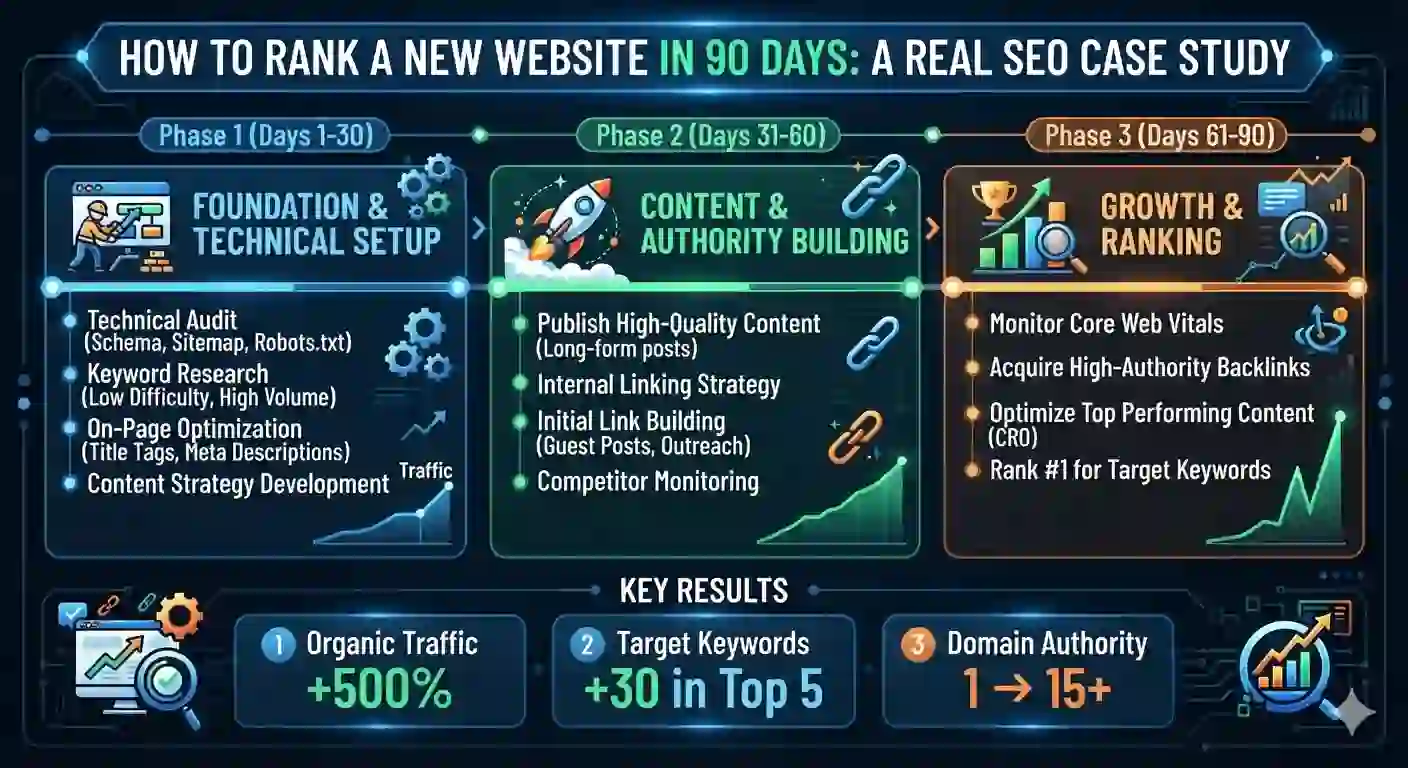
Weeks 1–2: Technical SEO Foundation
Before writing a single blog post, the technical groundwork was set:
- Clean site architecture with logical URL structure
- Mobile-first, fast-loading design (Core Web Vitals optimized)
- XML sitemap submitted to Google Search Console
- Robots.txt configured correctly
- SSL, canonical tags, and schema markup implemented
- Internal linking structure planned before content even went live
Technical SEO is the skeleton your content hangs on. Skipping this step is one of the top reasons new websites fail to rank. If your Core Web Vitals need work, our guide on fixing LCP, FID, and CLS issues covers this in detail.
Weeks 3–4: Keyword Research and Content Planning
This is where most new websites either win or lose the 90-day race. Instead of chasing high-volume, high-competition head terms, the strategy focused on:
- Long-tail keywords with clear search intent
- Low-competition, high-relevance topics
- Question-based and FAQ-style keywords (great for featured snippets and AI Overviews)
- Semantic keyword clusters, not just isolated terms
Rather than writing one article per keyword, keywords were grouped into topic clusters — one pillar page supported by several related, interlinked articles. This is a core semantic SEO principle: Google increasingly ranks pages based on topical depth and entity relationships, not just keyword matching. For a full walkthrough of this process, see our complete keyword research guide.
Weeks 5–8: Content Creation and On-Page SEO
This was the highest-effort phase. Roughly 15–20 pieces of content were published across four weeks, each following a strict on-page SEO checklist:
- Primary keyword in the title (H1), URL, and first 100 words
- Secondary and LSI keywords naturally woven throughout
- Descriptive H2/H3 subheadings structured around user questions
- Short paragraphs, bullet points, and scannable formatting
- Internal links to related pages on the site
- One authoritative external link per article (e.g., Google Search Central, Moz, or industry data sources)
- Optimized meta titles and descriptions
- Compressed, alt-tagged images
Every article was written to be genuinely helpful first, keyword-optimized second — this is the E-E-A-T principle in action. Google’s own guidance rewards content that demonstrates real experience and expertise, not just keyword density. For the exact checklist used, see our 25-point on-page SEO checklist, and to understand E-E-A-T more deeply, read how E-E-A-T builds website authority.
Weeks 9–10: Strategic Link Building
With 15–20 pages of solid content live, the focus shifted to earning early backlinks:
- Guest posts on relevant, niche-related blogs
- Directory and citation listings for local/location relevance
- Digital PR outreach for natural mentions
- Internal linking audits to distribute authority across the site
Link building for a brand-new domain requires patience and relevance over volume. A handful of quality, contextual backlinks outperform dozens of spammy ones. Our full breakdown of link building strategies that actually work in 2026 covers this process in more depth.
Weeks 11–12: Monitoring, Analysis, and Optimization
In the final stretch, the focus moved to data:
- Tracking keyword rankings weekly via Google Search Console
- Identifying “striking distance” keywords (ranking positions 8–20) and optimizing those pages further
- Updating meta descriptions and titles based on click-through rate data
- Fixing any crawl errors or indexing issues
- Adding FAQ schema to boost visibility in AI Overviews and featured snippets
This iterative optimization phase is often skipped by beginners — but it’s where a lot of the ranking gains actually happen.
Key SEO Strategies That Made This Work
A few strategic decisions had an outsized impact on results:
- Topic clusters over isolated posts — building semantic authority around a core theme rather than scattering unrelated content.
- Long-tail keyword prioritization — targeting realistic, winnable keywords instead of head terms with no chance of ranking in 90 days.
- FAQ and question-based content — structured for direct, snippet-style answers, which increases the odds of appearing in Google’s AI Overview.
- Consistent publishing cadence — signaling to Google that the site is active and well-maintained.
- Technical health first — a fast, crawlable, mobile-friendly site gave every piece of content a fair chance to rank.
Real Results: Traffic and Ranking Growth
By day 90, the site saw:
- Indexing of all core pages within the first two weeks
- Multiple keywords ranking on page 1–2 of Google
- A steady increase in organic impressions and clicks in Google Search Console
- Early appearances in “People Also Ask” and related search boxes
- The beginning of topical trust signals that continued to compound after day 90
The biggest takeaway: results weren’t instant or linear. Rankings came in waves — a slow first month, followed by a noticeable jump around week 6–8 as Google began trusting the domain more.
Common Mistakes That Slow Down New Website Rankings
If you’re trying to replicate results like this, avoid these common pitfalls:
- Publishing too little content — inconsistency signals a low-priority site to Google
- Ignoring technical SEO — even great content won’t rank on a slow, poorly structured site
- Keyword stuffing — hurts readability and can trigger quality issues
- Skipping internal linking — isolated pages struggle to build authority
- Targeting only high-competition keywords — unrealistic for a new domain within 90 days
- No search intent match — content that doesn’t answer the actual query won’t hold rankings
Why Choose FlowStackHub for Your SEO Strategy
Executing a 90-day SEO plan like this takes more than knowledge — it takes structured execution across technical SEO, content, and link building at the same time. At FlowStackHub, this exact framework — technical audits, keyword clustering, EEAT-driven content, and strategic link building — is applied to real client websites. If you want a tailored roadmap for your own site, you can explore our SEO services or learn more about our team and approach.
Frequently Asked Questions
Can a new website really rank on Google in 90 days?
Yes, for long-tail and low-to-medium competition keywords. Ranking for highly competitive head terms usually takes longer, but a focused 90-day plan can produce real, measurable visibility.
How many blog posts does it take to rank a new website?
There’s no fixed number, but this case study published 15–20 well-optimized, topic-clustered articles within the first two months, which was enough to establish early topical authority.
Do new websites need backlinks to rank quickly?
Backlinks help, but they’re not the only factor. Strong technical SEO, on-page optimization, and content that matches search intent can produce rankings even before a large backlink profile is built.
What’s the fastest way to rank a new website?
Focus on technical SEO first, then target long-tail, low-competition keywords with well-structured, genuinely helpful content — rather than competing immediately for broad, high-volume terms.
Does domain age affect ranking speed?
It can play a minor role, but it’s not a hard blocker. Sites with strong technical foundations and quality content can rank well before their domain “ages,” as seen in this case study.
How do I know if my SEO strategy is working?
Track weekly keyword position changes, organic impressions, and clicks in Google Search Console. Early movement in “striking distance” keywords (positions 8–20) is a strong sign your strategy is working.
Conclusion
Ranking a new website in 90 days isn’t about shortcuts or gimmicks — it’s about doing the fundamentals well, in the right order, and consistently. Technical SEO first, smart keyword targeting second, genuinely helpful content third, and strategic link building to reinforce it all. This case study shows it’s achievable with a disciplined, structured approach.
If you’re ready to apply a proven 90-day SEO framework to your own website, book a strategy session with FlowStackHub and let’s build your ranking roadmap together.



[…] aap janna chahte hain ke naye website ko rank karne mein kitna waqt lagta hai, to hamara 90-day SEO case study zaroor dekhein — jahan hum ne real data ke sath dikhaya hai ke AI-assisted SEO strategy ne kaise […]