

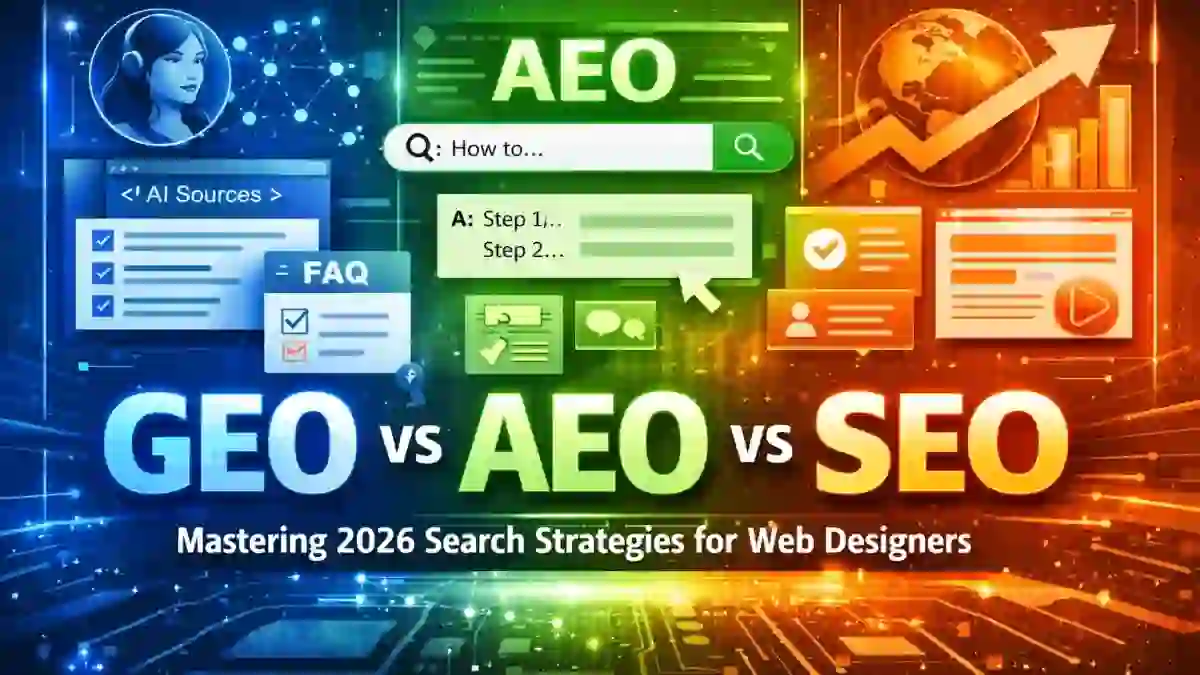
The way people find information online is changing faster than at any point since the launch of mobile-first indexing. Search engines are no longer the only doorway to your website — AI answer engines and generative search tools like ChatGPT, Perplexity, and Google’s AI Overviews are now deciding which brands get mentioned, summarized, and recommended. This shift means web design in 2026 isn’t just about how a site looks — it’s about how well an AI system can read, understand, and trust it.
In this guide, we’ll break down the biggest web design trends of 2026, explain what Answer Engine Optimization (AEO) and Generative Engine Optimization (GEO) actually mean for your website, and show you exactly how to prepare your site for this new era of search — whether you’re a business owner, a freelance designer, or someone exploring a career in web design.
What Is AEO and GEO — And Why Should Web Designers Care?
Before diving into trends, it helps to understand the two acronyms shaping this year’s conversation.
- AEO (Answer Engine Optimization) is the practice of structuring your content so voice assistants and answer engines (like Google’s featured snippets or Siri) can pull a direct, accurate answer from your page.
- GEO (Generative Engine Optimization) is the newer discipline of optimizing content so generative AI tools — ChatGPT, Gemini, Claude, Perplexity — cite, summarize, or recommend your site when a user asks a question.
Both are different from traditional SEO in one key way: instead of optimizing purely for rankings, you’re optimizing for machine comprehension. If an AI crawler can’t parse your page structure, your content simply won’t be surfaced — no matter how good the writing is.
For web designers, this changes the job. Layout, code structure, and content hierarchy are no longer just about human readability and aesthetics; they’re about giving AI systems something clean to read.
Why AEO & GEO Readiness Matters in 2026
A growing share of search traffic now starts — and sometimes ends — inside an AI-generated answer. When a user gets a complete answer from an AI Overview or a chatbot, they often never click through to a website at all. That means:
- Brands that don’t appear in AI-generated answers become invisible to a large chunk of their audience.
- Poorly structured websites (heavy JavaScript, no schema, unclear headings) get skipped by AI crawlers in favor of cleaner competitors.
- Trust signals — author bios, citations, structured data — matter more than ever, because AI models are trained to prefer credible, well-organized sources.
In short: a beautiful website that isn’t machine-readable is quickly becoming a liability, not an asset.
Key Web Design Trends for 2026
1. AI-Readable Content Architecture
Clear H1–H3 hierarchies, short paragraphs, and direct question-and-answer formatting aren’t just good UX anymore — they’re how AI models extract meaning. Designers are increasingly building page templates around “snippet-friendly” blocks: a question as a heading, followed immediately by a concise, factual answer.
2. Structured Data and Schema Markup Everywhere
Schema.org markup (FAQ schema, Article schema, Organization schema, Product schema) tells search engines and AI systems exactly what your content is about. In 2026, schema isn’t optional for competitive sites — it’s a baseline requirement, alongside tools like Google’s Rich Results Test to validate implementation.
3. Mobile-First, Performance-First Design
Google’s mobile-first indexing has been standard for years, but in 2026 speed matters even more, because AI crawlers and answer engines favor pages that load fast and render cleanly without heavy client-side rendering. Core Web Vitals — LCP, INP, and CLS — remain central to both user experience and AI visibility. If you haven’t audited your site’s Core Web Vitals recently, it’s worth revisiting the fundamentals of load speed and layout stability.
4. Progressive Web Apps (PWAs)
PWAs continue gaining ground because they combine the speed and reliability of a native app with the accessibility of a website — no app store required. For businesses wanting an app-like experience without app development costs, PWAs are a practical 2026 trend worth considering.
5. Conversational Interfaces and AI Chatbots
Embedded AI chat widgets are becoming a standard design element, helping visitors get instant answers directly on-site — which also generates structured, answerable content that GEO-focused crawlers can learn from.
6. Neo-Brutalist and Bold Typography-Led Design
On the visual side, 2026 has seen a swing toward bold, high-contrast, typography-driven layouts — a reaction to years of minimalist sameness. This trend favors distinctive brand identity, which also helps AI systems and users alike distinguish credible, original sources from generic template sites.
7. E-E-A-T Signals Built Into Design
Experience, Expertise, Authoritativeness, and Trustworthiness (E-E-A-T) is a Google framework, but it’s increasingly relevant to AI answer engines too. Designers are now expected to build in visible author bios, citation sections, and “last updated” timestamps as standard page elements — not afterthoughts.
Key Skills, Tools & Benefits for Designers and Businesses
Skills that matter in 2026:
- HTML semantic structure and accessibility best practices
- Basic schema/structured data implementation
- Core Web Vitals optimization
- Content structuring for AI readability (not just visual layout)
- Familiarity with AI-assisted design tools (Framer AI, and similar no-code/low-code platforms)
Tools worth learning:
- Google Search Central documentation and Rich Results Test for structured data
- PageSpeed Insights / GTmetrix for performance auditing
- Schema markup generators for FAQ, Article, and Organization types
- AI search visibility trackers (emerging category of tools measuring GEO performance)
Benefits of getting this right:
- Better visibility inside AI Overviews and chatbot answers
- Improved organic rankings, since AEO/GEO practices overlap heavily with strong technical SEO
- Higher user trust and lower bounce rates from faster, cleaner pages
- A meaningful competitive edge, since most small business websites still haven’t adapted
Job Scope, Demand & Career Opportunities
Demand for designers who understand both aesthetics and technical/AI readiness is rising quickly. Roles blending web design with technical SEO, structured data, and AI-search strategy are becoming their own specialization — sometimes labeled “AI search optimization” or “GEO specialist” roles. Freelancers and agencies that can offer AEO/GEO-ready builds, not just visual design, are positioned to charge a premium over template-based competitors.
This is also a strong entry point for students and career-changers: the field rewards people who combine basic coding literacy with content strategy thinking, rather than requiring years of deep specialization in either alone. As AI search continues to grow, this hybrid skill set — part designer, part technical SEO strategist — is likely to remain in demand well beyond 2026.
Why Choose FlowStack Hub
If all of this feels like a lot to implement alone, that’s where an experienced team helps. FlowStack Hub specializes in building websites that aren’t just visually polished but are engineered from the ground up for modern search — combining clean semantic code, schema markup, Core Web Vitals optimization, and AEO/GEO-ready content structure. Whether you need a full website rebuild or a technical audit of your current site, the team focuses on measurable visibility, not just design trends for their own sake. You can explore FlowStack Hub’s services to see how these principles are applied in real client projects.
How to Learn AEO & GEO-Ready Web Design (Free + Paid Resources)
Free resources:
- Google Search Central’s official documentation on structured data and mobile-first indexing
- Web.dev (Google’s own performance and Core Web Vitals learning hub)
- Schema.org’s official reference for markup types
- FlowStack Hub’s own blog, including guides like what SEO actually means for beginners and a practical 25-point on-page SEO checklist
Paid resources:
- Structured, project-based courses on platforms like Coursera or LinkedIn Learning covering web performance and technical SEO
- Paid tools such as Semrush or Ahrefs for deeper technical audits — if you’re unsure which to pick, this comparison of Semrush, Ahrefs, and Ubersuggest is a useful starting point
For an authoritative, non-commercial reference, Google’s own developer documentation at developers.google.com/search remains one of the most reliable sources for how structured data and page experience actually affect visibility.
Real-World Examples
- A local service business that added FAQ schema to its service pages started appearing in Google’s “People Also Ask” boxes within weeks — a direct, measurable AEO win.
- An e-commerce brand that improved its Core Web Vitals scores saw a noticeable drop in bounce rate, since pages loaded and stabilized faster on mobile — a performance-first design trend paying off directly.
- Businesses publishing clear, well-structured “what is” and “how to” content have started getting cited directly inside AI chatbot answers, driving referral traffic from a source that barely existed two years ago.
Future Career & Business Opportunities
Looking beyond 2026, expect AEO and GEO to become as standard as mobile responsiveness is today — not a niche specialty, but a baseline expectation. Designers who build fluency now, in structured data, performance optimization, and AI-readable content architecture, will have a lasting advantage. For businesses, investing early in AEO/GEO-ready design means capturing visibility in AI search results before the space becomes as competitive as traditional SEO is today.
FAQs
What’s the difference between SEO, AEO, and GEO?
SEO optimizes for traditional search engine rankings. AEO focuses on getting direct answers pulled into featured snippets and voice results. GEO optimizes content specifically so generative AI tools cite or summarize it in their responses. They overlap heavily but require slightly different technical and content strategies.
Do I need to redesign my whole website for AEO/GEO?
Not necessarily. Many improvements — adding schema markup, restructuring headings, improving load speed — can be layered onto an existing site without a full rebuild.
Is schema markup really necessary in 2026?
Yes. Schema markup is one of the clearest ways to tell both search engines and AI systems exactly what your content means, and it directly supports both AEO and GEO visibility.
How long does it take to see results from AEO/GEO optimization?
Similar to SEO, results vary, but structural changes like schema markup and improved page speed can show measurable impact within weeks, while broader AI-search visibility often builds over a few months.
Can a small business realistically compete in AI search results?
Yes — often more easily than in traditional SEO, since AI search rewards clear, well-structured, trustworthy content over sheer domain authority, leveling the playing field for smaller, well-optimized sites.
Do I need a developer to implement these changes?
Basic schema and content structure changes can often be done by a designer or content team, but for deeper technical work — like fixing Core Web Vitals issues or restructuring site architecture — a developer or specialized agency is recommended.
Conclusion
Web design in 2026 is no longer just about how a site looks to human visitors — it’s about how well it communicates with the AI systems now shaping how people discover information. Businesses and designers who adapt early, by embracing structured data, performance-first design, and AI-readable content, will be the ones showing up in tomorrow’s answers.
If you’re ready to make your website AEO and GEO-ready, book a seat with FlowStack Hub’s Advanced Services and let’s build a site that’s designed to be found — by humans and AI alike.