

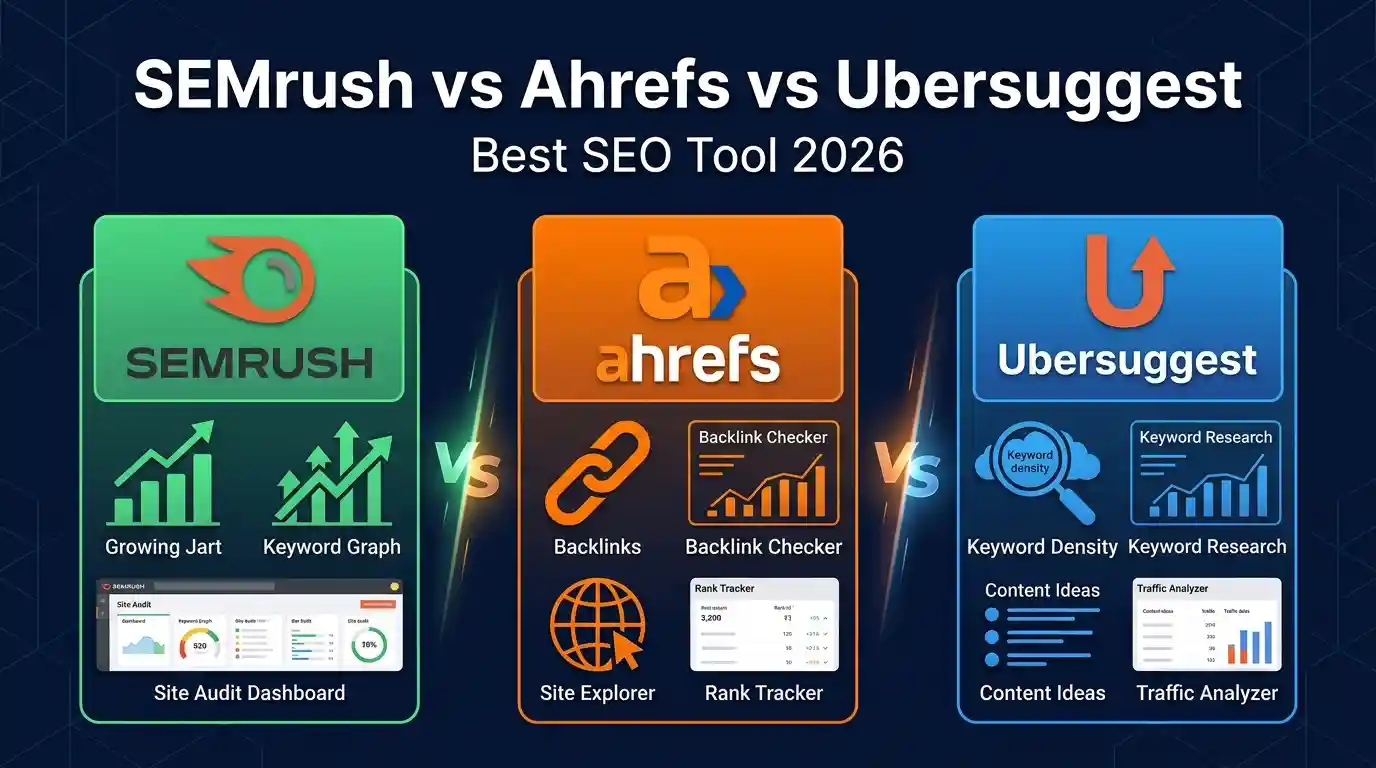
You’re staring at 3 browser tabs. SEMrush. Ahrefs. Ubersuggest. All promising the same thing. All priced completely differently. And you need to pick one.
Here’s the honest breakdown, no sponsored opinions, no vague “it depends” cop-outs. Just what each tool actually does well, where it falls short, and who should be paying for it in 2026.
What these tools actually do
All 3 are SEO platforms. They help you find keywords, track rankings, analyze backlinks, and audit your site for technical issues. On paper, they look identical.
Open them side by side and the differences become obvious fast.
SEMrush is a full digital marketing platform. Keyword research, PPC analysis, social media, content marketing, competitor intelligence, and now AI visibility tracking. It’s the widest tool of the 3.
Ahrefs is built for deep SEO analysis. Backlink data is where it’s historically been strongest, and its keyword database is enormous. If you live inside organic search strategy, Ahrefs was built for you.
Ubersuggest is Neil Patel’s tool. It handles the core SEO tasks, keyword ideas, rank tracking, site audits, and basic backlink data, at a fraction of the price. And yes, there’s a lifetime deal. More on that shortly.
The 2026 context: why this comparison matters more now
The global SEO software market is projected to surpass $105 billion by 2026. Teams are paying $100 to $500 per month on tools, and many are running 2 or 3 platforms simultaneously because no single tool covers everything perfectly.
That’s a real cost. Picking the wrong one wastes money and gives you false confidence in data that isn’t accurate enough to act on.
The data quality gap between Ubersuggest and the premium tools widened in 2026 as Ahrefs and SEMrush continued improving their crawlers. So this decision matters more than it did 2 years ago.
SEMrush: the all-in-one platform
SEMrush was founded in 2008 and is used by over 10 million marketing professionals worldwide, including in-house teams at Amazon, Tesla, Samsung, and Forbes.
It covers more ground than any other tool in this comparison. SEO, PPC, content, social, competitive intelligence. All in one dashboard.
Where SEMrush wins:
The Keyword Magic Tool has one of the largest keyword databases available. You type one seed keyword and get thousands of variations organized by topic cluster, search intent, and keyword difficulty.
SEMrush dominates competitor analysis with its Traffic Analytics tool, which extends beyond organic search to show what keywords competitors bid on, their PPC ad copy, and social media performance. If a competitor is getting traffic from paid campaigns or YouTube, SEMrush shows it.
SEMrush also launched the AI Visibility Toolkit in 2026. It tracks how often your brand appears in AI answers and provides sentiment analysis showing exactly how AI talks about you. For anyone trying to rank in ChatGPT, Gemini, or Perplexity, this is the only tool in this comparison with dedicated AI search tracking.
The On Page SEO Checker gives you specific, page-level recommendations. Not generic advice, actual changes tied to what your top 10 competitors are doing on the same keyword.
Where SEMrush falls short:
Price. The Pro plan starts at $139.95/month. For solo operators or small teams doing basic SEO, that’s a lot. And the credit system for certain features can feel restrictive.
The interface has a learning curve. There’s a lot of it. If you want to run a quick keyword check, you’ll wade through more menus than you need.
Best for: Agencies, in-house marketing teams, anyone running SEO alongside PPC or content marketing, and anyone who needs to track AI search visibility.
Ahrefs: the backlink and content research specialist
Ahrefs built its reputation on backlink data. It’s widely known as one of the best SEO tools for backlink analysis. That reputation is still accurate in 2026.
Where Ahrefs wins:
Site Explorer is the core product. You type any domain or URL and get a full picture: organic traffic estimates, top pages, keyword rankings, and the full backlink profile. The data is reliable enough that most SEO professionals treat it as a reference standard.
The Content Explorer tool is genuinely useful for content strategy. Search any topic and find the pages getting the most organic traffic and backlinks on that subject. It’s a fast way to find proven content angles before writing a single word.
Ahrefs pushes you toward competitive analysis almost immediately. You type a keyword and the first thing you see is the list of pages already ranking, with strong domain profiles and backlink counts. That information can change your decision in seconds. A keyword may look attractive until you see that the entire first page belongs to high-authority sites.
The historical keyword data goes back years. If you want to see how a keyword’s search volume has changed over time, Ahrefs gives you a much longer view than Ubersuggest’s 12-month window.
Ahrefs introduced “Brand Radar” to track text mentions across the web, though it lacks the deep share-of-voice AI metrics that SEMrush provides.
Where Ahrefs falls short:
No PPC data. If your competitor is getting half their business from Google Ads, Ahrefs can’t show you that. You’re limited to organic search.
Ahrefs’ credit system is too restrictive for team research. Heavy users burn through credits faster than expected, which becomes a real operational frustration at agencies.
Site audit is functional but less detailed than SEMrush’s. It catches technical issues, but the recommendations are less specific.
Best for: SEO specialists, content marketers, link building teams, and anyone whose primary focus is organic search and backlink strategy.
Ubersuggest: the budget-friendly entry point
Ubersuggest is the right tool for solo business owners, small businesses, bloggers, and startups that need directional SEO data without the premium price tag.
It’s ideal for bloggers, solopreneurs, and small business owners who are new to SEO and working with a tight budget.
Where Ubersuggest wins:
Price. The monthly plan starts at $29. And the lifetime deal (a one-time payment, no recurring subscription) is genuinely one of the better value propositions in SEO software if you’re just getting started.
Ubersuggest bundles AI writing assistance, AI title generation, and AI content ideas into its plans, adding functionality that would cost extra elsewhere.
The interface is clean and beginner-friendly. You don’t need to know what “domain rating” or “URL rating” means to start getting useful information out of it.
Where Ubersuggest falls short:
Ahrefs and SEMrush catch more backlinks, show more accurate volume estimates, and surface competitor data more reliably. For basic directional research, Ubersuggest works fine. For client deliverables or competitive niches where accuracy matters, the gaps show up.
Only 12 months of historical keyword data. No PPC competitor research. Limited crawl depth on large sites.
Agencies and SEO specialists cannot rely on Ubersuggest for client deliverables that require accurate, auditable data.
Best for: Bloggers, small business owners, freelancers just starting out, and anyone who needs directional SEO data without a serious recurring cost.
Feature comparison table
| Feature | SEMrush | Ahrefs | Ubersuggest |
|---|---|---|---|
| Keyword research | Excellent | Excellent | Good |
| Backlink analysis | Excellent | Best-in-class | Basic |
| Site audit | Excellent | Good | Basic |
| Rank tracking | Excellent | Excellent | Good |
| Competitor analysis | Best-in-class | Good (organic only) | Limited |
| PPC research | Yes | No | No |
| AI visibility tracking | Yes (AI Toolkit) | Partial (Brand Radar) | No |
| Content research | Good | Excellent | Basic |
| Ease of use | Medium | Medium | Easy |
| Starting price | $139.95/mo | $129/mo | $29/mo |
| Lifetime deal | No | No | Yes |
| Best for | Agencies, full-stack marketing | SEO specialists, link builders | Beginners, small businesses |
Pricing breakdown (2026)
SEMrush:
- Pro: $139.95/month (1 user, 5 projects)
- Guru: $249.95/month (3 users, 15 projects, historical data)
- Business: $499.95/month (5 users, 40 projects)
Ahrefs:
- Lite: $129/month (1 user, 5 projects)
- Standard: $249/month (1 user, 20 projects)
- Advanced: $449/month (3 users, 50 projects)
Ubersuggest:
- Individual: $29/month
- Business: $49/month
- Enterprise: $99/month
- Lifetime plans available (one-time payment)
The pricing gap between Ubersuggest and the premium tools is real. So is the data quality gap. SEMrush comes at a much higher price point than Ubersuggest, but its feature set offers a lot more for the money compared to key competitors like Moz and Similarweb.
Who should use which tool
You’re an agency or full-service marketing team: SEMrush. The competitor intelligence, PPC data, AI visibility tracking, and white-label reporting all justify the price when you’re managing clients across multiple channels.
You’re an SEO specialist focused on organic search and link building: Ahrefs. The backlink database, Content Explorer, and historical data are the best in the comparison for pure SEO work.
You’re a blogger, small business owner, or just getting started: Ubersuggest. Start with Ubersuggest. The $29/month or lifetime option gives you enough to build keyword-informed content without a large recurring commitment. Upgrade when SEO is generating enough traffic to justify the premium.
You need both SEO and PPC competitive intelligence: SEMrush, no question.
You’re running ecommerce SEO on Shopify or WooCommerce: Either Ahrefs or SEMrush. Both handle technical site audits and keyword gap analysis well for product-heavy sites.
Do you need all 3?
Some professionals do run SEMrush and Ahrefs together. SEMrush for PPC data and broad competitive intelligence. Ahrefs for backlink prospecting and content research.
But for most teams, that’s duplication. Pick one premium tool based on your primary workflow. Use Google Search Console (free) to supplement with real ranking data. Add Ubersuggest only if budget is the main constraint and you’re early in your SEO work.
If you’re still building the fundamentals before choosing a tool stack, the complete SEO beginner’s guide on Flow Stack Hub is a good starting point. And if you’ve already hit a wall with rankings despite using tools, this breakdown of why websites stop ranking often points to issues no tool catches on its own.
SEO tools in Pakistan, India, UAE, and South Asia
Pricing is a real consideration in markets like Pakistan, India, and the UAE where $140/month for SEMrush is a significant monthly cost.
Ubersuggest’s lifetime deal makes a lot of sense here. Pay once, use indefinitely. For freelancers in Islamabad, Lahore, Karachi, and Rawalpindi building out client SEO work, the lifetime plan removes the recurring subscription pressure entirely.
Once client revenue justifies it, upgrading to Ahrefs Lite or SEMrush Pro becomes a natural step. Many SEO consultants in South Asia run Ubersuggest for their own projects and bill clients under SEMrush or Ahrefs for deliverable-grade reporting.
For a full picture of keyword research strategy alongside your tool choice, the keyword research pro guide covers the process in detail. And if you’re helping a small business decide whether SEO is worth the investment at all, this guide on SEO for small businesses answers that question directly.
How these tools handle AI search in 2026
This is where the comparison gets more interesting. Google AI Overviews, ChatGPT search, Perplexity, and Gemini are sending traffic now, and traditional rank tracking doesn’t capture any of it.
SEMrush’s AI Visibility Toolkit tracks exactly how often your brand appears in AI answers and provides sentiment analysis. Ahrefs has Brand Radar for mention tracking but lacks the deep share-of-voice chat metrics that SEMrush provides. Moz and Ubersuggest currently lag in dedicated AI tracking features.
If generative engine optimization (GEO) is part of your 2026 strategy, SEMrush is currently the only tool in this comparison with real infrastructure for tracking it.
For a broader view of technical SEO requirements that feed both traditional rankings and AI search, the on-page SEO checklist covers the technical elements that both Google and AI search engines evaluate.
Google’s own Search Central documentation is still the authoritative source for understanding what signals actually move rankings. Worth reading alongside any tool’s recommendations.
FAQ: SEMrush vs Ahrefs vs Ubersuggest
What is the best SEO tool in 2026? SEMrush is the most complete platform for full-stack digital marketing. Ahrefs is the best for pure SEO and backlink work. Ubersuggest is the best for beginners and budget-limited users.
Is SEMrush better than Ahrefs? For agencies and teams running SEO alongside PPC, SEMrush has more features. For focused organic SEO and link building, Ahrefs has deeper data and better backlink intelligence.
Is Ubersuggest good enough for SEO? For keyword research, basic rank tracking, and site audits on smaller sites, yes. For competitive analysis or client-level reporting that requires high data accuracy, the premium tools are more reliable.
What is the cheapest professional SEO tool? Ubersuggest at $29/month is the most affordable entry-level option with enough features to start. The lifetime deal makes it even more cost-effective long-term.
Does SEMrush track AI search results? Yes. SEMrush’s AI Visibility Toolkit tracks brand mentions and share of voice in AI-generated answers from tools like ChatGPT and Gemini. Ahrefs has partial tracking through Brand Radar. Ubersuggest has no AI search tracking.
Which SEO tool is best for keyword research? SEMrush and Ahrefs both have large, accurate keyword databases. SEMrush’s Keyword Magic Tool is slightly better for topic clustering. Ahrefs’ Keywords Explorer is better for evaluating ranking difficulty with precision.
Is Ahrefs worth the price? Yes, if backlink strategy and content research are central to your SEO work. The data quality and depth of Site Explorer and Content Explorer justify the $129/month Lite plan for anyone doing serious organic search work.
What SEO tools do professionals use? Most professionals use SEMrush or Ahrefs as their primary tool, supplement with Google Search Console for real ranking data, and use Screaming Frog for deep technical crawls. Ubersuggest appears more often in smaller teams and solo operations.
The verdict
Pick SEMrush if you want one tool to cover SEO, PPC, content, and AI visibility. Pick Ahrefs if organic search and backlinks are your primary focus and you want the most accurate data in that space. Start with Ubersuggest if budget is the constraint and you’re building your SEO foundation.
And if you want experienced help building the right SEO strategy alongside the right tools, the advanced digital services team at Flow Stack Hub handles tool selection, technical audits, and full SEO execution.
Book a consultation with Flow Stack Hub and get a clear picture of which tool stack fits your goals, and what to do with it once you have it.

[…] keywords can rank in weeks. High-competition terms take months or years. Use tools like SEMrush, Ahrefs, or Ubersuggest to check keyword difficulty scores before targeting […]
[…] Ahrefs or SEMrush: For keyword difficulty and search volume on longer conversational queries. For a comparison of which tool works best for different use cases, see SEMrush vs Ahrefs vs Ubersuggest. […]
[…] your site through a crawl tool like Screaming Frog or use SEMrush or Ahrefs to audit image issues across your full […]
[…] — useful for ongoing monitoring. If you’re deciding between platforms, our comparison of Semrush vs Ahrefs vs Ubersuggest breaks down which tool fits which budget and use […]