

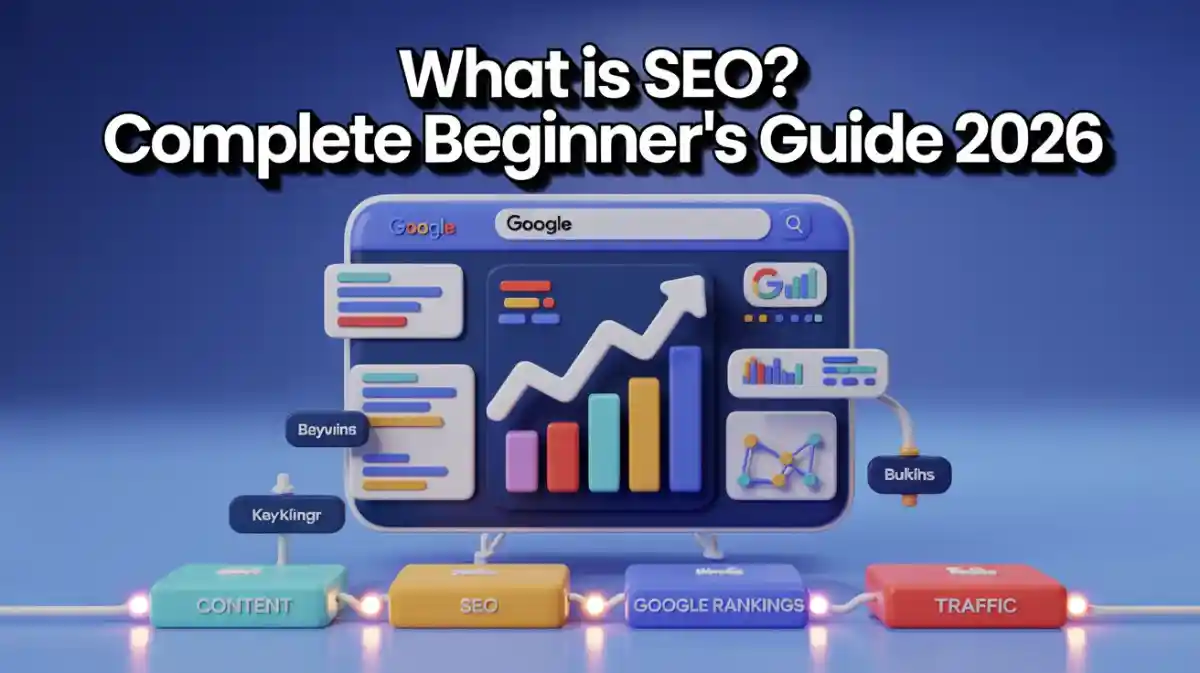
Everything you need to know about Search Engine Optimization — from absolute basics to AI-era strategies
If you’ve ever wondered why some websites show up at the top of Google while others are buried on page 10, the answer is almost always SEO.
Search Engine Optimization — or SEO — is the process of making your website more visible on search engines like Google, Bing, and even AI-powered search platforms. In 2026, SEO has evolved dramatically. It’s no longer just about stuffing keywords into a blog post. It’s about building real authority, answering real questions, and getting cited by AI systems like Google’s AI Overviews, ChatGPT Search, and Perplexity.
Whether you’re a complete beginner, a small business owner in Pakistan, or someone looking to build a digital career, this guide will walk you through everything — step by step, plain and simple.
Let’s begin.
What is SEO? (Simple Definition)
SEO stands for Search Engine Optimization.
In simple words, SEO is the practice of optimizing your website so that search engines understand it, trust it, and rank it higher in search results — without paying for ads.
When someone types “best digital marketing agency in Islamabad” into Google, the results that appear aren’t random. Google runs those websites through hundreds of ranking signals — content quality, backlinks, page speed, user experience, authority, and more — and then decides who deserves to be on top.
SEO is the art and science of making sure your website wins that decision.
Think of Google as a librarian. Your website is a book. SEO is how you write, organize, and market that book so the librarian recommends it first to every reader searching for that topic.
Why is SEO Important in 2026?
Here’s a truth that surprises most beginners: over 60% of all clicks online come from organic search — meaning free search results, not paid ads.
That’s massive. And in 2026, the stakes are even higher because:
- Google now processes over 14 billion search queries per day
- AI Overviews appear at the top of search results for billions of queries globally
- Zero-click searches (where Google answers the question directly on the SERP) now account for nearly 60% of all searches
- AI traffic converts at 23x higher rates than traditional search traffic
This means that if your website isn’t optimized for SEO — and for AI-powered search — you’re practically invisible.
For businesses in Pakistan, this matters even more. Whether you run a restaurant in Lahore, a law firm in Islamabad, or an e-commerce store serving customers across the country, SEO is the most cost-effective way to reach your audience without burning a budget on paid ads every single month.
Want to see how SEO can directly grow a business like yours? Read our guide on SEO for Small Businesses to understand the real-world impact.
How Do Search Engines Work?
Before you can master SEO, you need to understand what search engines actually do. It all happens in three stages:
1. Crawling
Search engines use automated bots called Googlebot (or crawlers/spiders) that browse the internet continuously, discovering new and updated web pages. These bots follow links from page to page — which is why internal linking and having a proper XML sitemap matter so much.
2. Indexing
Once a page is crawled, Google stores and organizes it in a massive database called the Google Index. If your page isn’t indexed, it simply doesn’t exist in search results — no matter how good your content is.
3. Ranking
When a user performs a search, Google pulls relevant pages from its index and ranks them based on hundreds of signals: relevance, authority, content quality, user experience, backlinks, and now — AI-understood semantic relevance.
Understanding this process is the foundation of all SEO work.
The 3 Main Types of SEO
Every SEO strategy is built on three core pillars. Let’s break them down:
On-Page SEO
On-page SEO refers to everything you do on your website to help search engines understand your content. This includes:
- Writing high-quality, relevant content that matches search intent
- Using proper title tags, meta descriptions, and H1/H2/H3 headings
- Adding keywords naturally throughout your content
- Optimizing images with descriptive alt text
- Creating clean URL structures (e.g.,
/what-is-seo/not/page?id=123) - Using internal links to connect related content
- Adding schema markup and structured data for rich snippets
On-page SEO is the foundation. Without it, nothing else works well.
Off-Page SEO
Off-page SEO involves everything that happens outside your website that affects your rankings. The most important off-page factor is backlinks — links from other websites pointing to yours.
Think of backlinks as votes of confidence. When a reputable website links to you, Google sees it as a trust signal. Other off-page factors include:
- Brand mentions across the web
- Social media presence and engagement
- Guest posting on authoritative sites
- Citations and directory listings (especially for local SEO)
- PR and digital outreach
In 2026, branded web mentions have a stronger correlation with AI Overview appearances than traditional backlinks — so building your brand online matters more than ever.
Technical SEO
Technical SEO is the behind-the-scenes work that makes your website accessible, fast, and easy for search engines to crawl and index. Key technical SEO elements include:
- Site speed and Core Web Vitals (Google’s performance metrics)
- Mobile-first indexing — your site must work perfectly on mobile
- HTTPS and SSL security
- Fixing 404 errors and setting up proper redirects
- Canonical tags to avoid duplicate content issues
- Robots.txt and XML sitemap configuration
- Structured data and schema markup implementation
If on-page SEO is the content of your book, technical SEO is making sure the book is properly printed, bound, and deliverable.
Keyword Research: The Heart of SEO
Keywords are the words and phrases people type into search engines. Keyword research is the process of finding which terms your target audience uses — and then creating content around those terms.
Here’s a simple keyword research process for beginners:
Step 1: Start with a broad topic (e.g., “digital marketing”) Step 2: Use free tools like Google Keyword Planner, Ubersuggest, or Toolify Worlds to find related keyword ideas Step 3: Look at search volume (how many people search it) and keyword difficulty (how hard it is to rank) Step 4: Identify the search intent behind each keyword — are people looking for information, a product, or a local service? Step 5: Group related keywords into topics and create content that covers each topic thoroughly
There are four main types of keywords:
- Short-tail keywords — broad and high-volume (e.g., “SEO”) — very competitive
- Long-tail keywords — specific and lower competition (e.g., “how to do SEO for a new website in 2026”) — easier to rank for
- LSI keywords — semantically related terms that add context to your content
- Local keywords — geo-specific terms like “SEO services in Islamabad” or “digital marketing agency Pakistan”
In 2026, search intent matters more than keyword density. Google’s algorithms — powered by RankBrain, BERT, and MUM — understand language at a deep level. Write for humans first, optimize for search engines second.
On-Page SEO Techniques: A Practical Checklist
Here are the most important on-page SEO factors every beginner should implement:
- Title Tag — Include your primary keyword near the beginning. Keep it under 60 characters. Example: “What is SEO? Complete Beginner’s Guide 2026”
- Meta Description — Write a compelling 150-160 character summary that includes your keyword and encourages clicks
- H1 Tag — Your page should have one clear H1 heading containing the main keyword
- H2 and H3 Subheadings — Use secondary and LSI keywords naturally in subheadings
- First 100 Words — Mention your primary keyword early in the introduction
- Internal Linking — Link to related pages on your site to help Google understand your content structure
- Image Alt Text — Describe every image with a keyword-relevant alt attribute
- URL Slug — Keep URLs short, clean, and keyword-rich
- Content Length — Comprehensive content (1,500–3,500 words) tends to rank better for competitive topics
- Keyword Placement — Use keywords naturally, not stuffed. Focus on covering the topic fully
Link Building: How to Build Authority
Link building is one of the most powerful — and most misunderstood — areas of SEO. The goal is simple: earn high-quality backlinks from authoritative websites in your industry.
Here are proven link building strategies that still work in 2026:
Guest Posting — Write valuable articles for other reputable blogs in your niche and include a natural backlink to your site.
Broken Link Building — Find broken links on other websites and offer your content as a replacement. Tools like Ahrefs make this process easy.
Resource Page Link Building — Identify resource pages in your niche and pitch your content as a valuable addition.
Digital PR — Get mentioned in news articles, industry reports, or expert roundups. Branded mentions now carry significant weight in AI-powered search.
Internal Link Building — Don’t underestimate internal links. A well-structured internal linking strategy distributes page authority across your site and helps Google discover all your important pages.
What to Avoid:
- Buying low-quality backlinks
- Participating in link farms or PBNs (Private Blog Networks)
- Using automated link-building software
Google’s algorithms are sophisticated enough to detect manipulative link schemes. Stick to white hat SEO — sustainable strategies that build genuine authority.
Local SEO: Get Found in Your City
If you run a local business — a restaurant, clinic, law firm, real estate agency, or any service-based business — local SEO is your most powerful marketing tool.
Local SEO helps your business appear when people search for services “near me” or in a specific city. Here’s what local SEO involves in 2026:
Google Business Profile — Claim and fully optimize your Google Business Profile (formerly Google My Business). This is the #1 factor for ranking in Google Maps and the local pack.
NAP Consistency — Your Name, Address, and Phone number must be identical across every directory, website, and social profile.
Local Citations — Get listed on reputable local directories like Yelp, Yellow Pages Pakistan, and industry-specific directories.
Local Keywords — Create content targeting city-specific search terms like “SEO services in Islamabad,” “digital marketing agency Lahore,” or “best SEO expert in Karachi.”
Hyper-Local Landing Pages — Build dedicated pages for each city or region you serve, complete with localized content and schema markup.
Reviews — Encourage satisfied customers to leave Google reviews. Positive reviews are a strong local ranking signal.
For businesses across Pakistan — from Islamabad and Lahore to Karachi and Faisalabad — local SEO is the fastest way to compete against larger brands with bigger budgets. Learn how hiring the right digital marketing agency can accelerate your local SEO results.
SEO and AI in 2026: The New Rules
This is where SEO has changed most dramatically — and where most beginners are completely unprepared.
In 2026, Google’s AI Overviews appear at the top of search results for billions of queries. ChatGPT Search, Perplexity, and Google Gemini are now answering user questions directly — often without requiring a click to any website.
This has created two new disciplines alongside traditional SEO:
Answer Engine Optimization (AEO) — Optimizing your content to be cited and quoted by AI-powered answer engines. AEO focuses on structured content, direct Q&A formatting, schema markup, and clear factual statements.
Generative Engine Optimization (GEO) — A broader strategy to ensure your brand and content appear in AI-generated responses across platforms like ChatGPT, Perplexity, Claude, and Google’s AI Mode.
How to optimize for AI Overviews:
- Write content that directly answers specific questions (use the Q&A format)
- Use FAQPage schema markup — adoption of this schema is rapidly increasing as AI search heavily cites FAQ content
- Structure content with clear headings, short paragraphs, and bullet lists
- Build branded web mentions across the internet — branded mentions have a correlation score of 0.664 with AI Overview appearances, far stronger than traditional backlinks (0.218)
- Establish strong E-E-A-T signals — Experience, Expertise, Authoritativeness, and Trustworthiness
- Use definite, clear language — AI systems prefer content that is factual and direct, not vague or hedged
- Aim for 5-7 statistics in your content — data-backed content earns 20% higher AI citation likelihood
The bottom line: AI hasn’t killed SEO. It has expanded it. Total search usage (combining traditional search and AI search platforms) has increased by 26% worldwide. The opportunity is bigger than ever — but the rules have changed.
E-E-A-T: Why Google Trusts Some Sites More Than Others
E-E-A-T stands for Experience, Expertise, Authoritativeness, and Trustworthiness — Google’s framework for evaluating content quality.
In 2026, E-E-A-T has shifted from a quality guideline to what functions as an actual ranking filter. Content without clear E-E-A-T signals increasingly fails to rank, regardless of how well it’s technically optimized.
Here’s how to build E-E-A-T:
- Experience — Show that real humans with real experience wrote your content. Include author bios, credentials, and first-hand examples.
- Expertise — Demonstrate deep knowledge of your subject. Cover topics thoroughly, cite reliable sources, and link to authoritative external resources like Google’s SEO Starter Guide.
- Authoritativeness — Build a reputation in your niche through backlinks, mentions, guest posts, and PR coverage.
- Trustworthiness — Use HTTPS, maintain accurate information, have a clear privacy policy and contact page, and keep your content updated.
The Flow Stack Hub team applies E-E-A-T principles to every piece of content we create for clients. Explore our digital marketing services to see how we implement these standards for real businesses.
Best Free SEO Tools for Beginners in 2026
You don’t need to spend money to start learning and doing SEO. Here are the best free tools:
Google Search Console — The most important free SEO tool. It shows you which keywords your site ranks for, how many clicks you get, technical issues, and indexing status. Every website owner should have this set up.
Google Analytics 4 (GA4) — Track your website traffic, user behavior, and conversion data. Essential for measuring your SEO performance.
Google Keyword Planner — Find keyword ideas and search volume data directly from Google.
Ubersuggest — Great for keyword research, competitor analysis, and content ideas. Free tier is very useful for beginners.
Google PageSpeed Insights — Check your page speed and Core Web Vitals scores — critical technical SEO factors.
Screaming Frog SEO Spider (Free Version) — Crawl up to 500 URLs for free and identify technical SEO issues like broken links, missing meta tags, and duplicate content.
Yoast SEO or RankMath (WordPress Plugins) — If your site runs on WordPress, these plugins make on-page SEO accessible to beginners with simple, guided optimization.
For more advanced tools, you can explore platforms like Toolify Worlds which aggregates a wide range of SEO and AI tools, or premium options like Ahrefs, SEMrush, and Surfer SEO once you’re ready to invest.
Common SEO Mistakes Beginners Make
Learning what NOT to do is just as important as learning best practices:
- Keyword stuffing — Repeating keywords unnaturally ruins readability and can get you penalized
- Ignoring mobile optimization — Over 60% of searches happen on mobile. A non-mobile-friendly site simply won’t rank well
- Skipping technical SEO — Slow pages, broken links, and crawl errors silently kill your rankings
- Creating thin content — Short, shallow articles that don’t genuinely help users fail to rank in 2026
- Ignoring search intent — Targeting a keyword without understanding what the searcher actually wants leads to high bounce rates
- Buying cheap backlinks — Low-quality links can get your site penalized or deindexed
- Not updating old content — Content freshness is a ranking factor. Outdated articles lose rankings over time
- Neglecting local SEO — If you serve local customers and you’re not optimizing for local search, you’re leaving money on the table
How Long Does SEO Take to Show Results?
This is the most common question from beginners — and the honest answer is: it depends.
For a brand new website, it typically takes 3 to 6 months to start seeing noticeable organic traffic from SEO. For competitive industries, it can take 6 to 12 months or longer to rank for high-volume keywords.
However, some things can speed up results:
- Targeting low-competition long-tail keywords early on
- Publishing high-quality content consistently
- Building backlinks from relevant, authoritative sources
- Fixing technical SEO issues quickly
- Having a well-structured, fast-loading website from day one
SEO is a long-term investment — but it’s the most sustainable and cost-effective digital marketing strategy available. Unlike paid ads, which stop the moment you stop paying, SEO builds compounding value over time.
SEO vs SEM vs PPC: What’s the Difference?
Many beginners confuse these terms:
SEO (Search Engine Optimization) — Free, organic traffic earned through content and optimization. Takes time but provides long-term, sustainable results.
SEM (Search Engine Marketing) — An umbrella term that includes both SEO and paid search advertising.
PPC (Pay-Per-Click) — Paid ads on search engines (like Google Ads). You pay every time someone clicks your ad. Results are instant but stop when your budget runs out.
The smartest digital marketing strategy combines SEO for long-term growth with targeted PPC for immediate visibility — especially for new businesses or product launches.
SEO Career Opportunities in Pakistan 2026
SEO is one of the most in-demand digital skills globally — and in Pakistan, the demand is growing rapidly.
As more businesses recognize the importance of online visibility, they need skilled SEO professionals who can deliver real results. Whether you’re looking for a full-time job, freelance work, or building your own agency, SEO offers genuine career opportunities.
Common SEO job roles include:
- SEO Executive
- SEO Specialist
- SEO Manager
- Content Writer (SEO-focused)
- Technical SEO Specialist
- Digital Marketing Manager
Where to find SEO jobs in Pakistan:
- Rozee.pk and Indeed Pakistan for corporate roles
- Upwork, Fiverr, and Freelancer.com for international freelance clients
- LinkedIn for agency and corporate positions in Lahore, Karachi, Islamabad, and remote work
To stand out as an SEO professional in 2026, you need to understand not just traditional SEO but also GEO, AEO, AI search optimization, and content strategy. These skills are what separate basic practitioners from true experts.
At Flow Stack Hub, we help businesses and aspiring SEO professionals level up. Check out how we choose the best digital marketing strategies for sustainable growth in 2026 and beyond.
Why Choose Flow Stack Hub for Your SEO?
If you’re a business owner looking for professional SEO help — or someone who wants to work with a team that truly understands the evolving digital landscape — Flow Stack Hub is built for exactly that.
Here’s what sets the Flow Stack Hub team apart:
- Real Results — We don’t just talk SEO. We implement, track, and optimize campaigns that drive actual organic traffic and leads
- Up-to-Date Expertise — Our team stays ahead of every Google algorithm update, AI search change, and industry shift
- Full-Service Digital Marketing — From technical SEO audits to content strategy, link building, local SEO, and AI-era optimization
- Pakistan-First Understanding — We understand the local market — Islamabad, Lahore, Karachi, and beyond — and create strategies that work for Pakistani businesses competing locally and internationally
- Transparent Reporting — You always know exactly what’s being done, why, and what results it’s driving
Explore our complete services portfolio or view our work to see the results we’ve delivered for real clients.
Ready to take the next step? Contact the Flow Stack Hub team today and let’s build an SEO strategy that actually grows your business.
Frequently Asked Questions (FAQs)
Q: What does SEO stand for? SEO stands for Search Engine Optimization. It is the process of optimizing a website to rank higher in organic (unpaid) search engine results, primarily on Google.
Q: Is SEO free or paid? SEO itself is free in the sense that you don’t pay for organic rankings. However, you may invest in SEO tools, content creation, or professional SEO services. Unlike PPC (paid ads), you don’t pay per click.
Q: Can I do SEO myself as a beginner? Yes, absolutely. Many beginners successfully learn and implement SEO using free tools like Google Search Console and Google Analytics, along with free educational resources. It takes time and consistency, but it is 100% learnable.
Q: How long does SEO take to work? Most websites begin to see noticeable SEO results within 3 to 6 months of consistent effort. Competitive industries may require 6 to 12 months or more to rank for high-value keywords.
Q: What is the difference between SEO and SEM? SEO refers specifically to organic search optimization — earning rankings without paying. SEM (Search Engine Marketing) is a broader term that includes both organic SEO and paid search advertising (PPC/Google Ads).
Q: What is Google AI Overview and how does SEO relate to it? Google AI Overview is a feature that shows AI-generated summaries at the top of search results. In 2026, appearing in AI Overviews requires strong E-E-A-T signals, well-structured content with clear answers, FAQ schema markup, and high brand visibility across the web.
Q: What are the most important SEO ranking factors in 2026? The most important ranking factors in 2026 include content quality and relevance, E-E-A-T signals, backlinks from authoritative sources, Core Web Vitals (page speed and user experience), mobile-friendliness, structured data, and brand mentions across the internet.
Q: What is Local SEO and who needs it? Local SEO is the practice of optimizing a website to appear in location-based searches. Any business that serves customers in a specific geographic area — restaurants, clinics, law firms, retail stores, real estate agencies — needs local SEO to be found by nearby customers.
Conclusion: Your SEO Journey Starts Now
SEO in 2026 is more exciting — and more important — than it has ever been. Yes, the landscape has changed with AI Overviews, zero-click searches, and generative engine optimization. But the core principle remains the same: create genuinely helpful content, build real authority, and make your website technically sound.
Whether you’re a student trying to learn a new skill, a small business owner in Pakistan trying to get found online, or a professional building a digital marketing career — SEO is one of the highest-return skills you can develop in 2026.
Start with the basics: understand how search engines work, do keyword research, optimize your pages, build quality backlinks, and fix your technical issues. As you grow, expand into local SEO, AI-era optimization, and content strategy.
And if you want expert help accelerating your results, the Flow Stack Hub team is ready to build a custom SEO strategy for your business — whether you’re a startup, an established brand, or a local business ready to dominate your city’s search results.
👉 Book a consultation with Flow Stack Hub and let’s grow your online presence — starting today.
For additional free SEO tools and AI-powered marketing resources, visit Toolify Worlds — a growing hub of tools for digital marketers and SEO professionals.
[…] of which — if you’re just getting started, our beginner’s guide to SEO 2026 breaks down every core concept in plain […]
[…] a broader foundation first? Read what SEO actually is before going deeper into local […]
[…] your site is new, also read our beginner’s guide to SEO to understand how Google discovery works from […]
[…] you’re working on broader SEO fundamentals alongside technical fixes, both need to happen […]
[…] you’re still building the fundamentals before choosing a tool stack, the complete SEO beginner’s guide on Flow Stack Hub is a good starting point. And if you’ve already hit a wall with rankings despite using tools, […]
[…] keywords early. Build domain authority on easier wins before going after hard keywords. Check our beginner’s guide to SEO for a solid starting […]
[…] you want to understand how this fits into the bigger SEO picture, this beginner’s guide to SEO is a solid starting point before going deeper on authority […]
[…] you want to understand how this fits into the bigger SEO picture, this beginner’s guide to SEO is a solid starting point before going deeper on authority […]
[…] you’re building a content and SEO strategy from the ground up, our beginner’s guide to SEO and keyword research guide are the right place to start before you get deep into off-page […]
[…] you’re new to SEO altogether, start with the complete beginner’s guide to SEO for 2026 before going deeper […]
[…] Hub’s own blog, including guides like what SEO actually means for beginners and a practical 25-point on-page SEO […]