


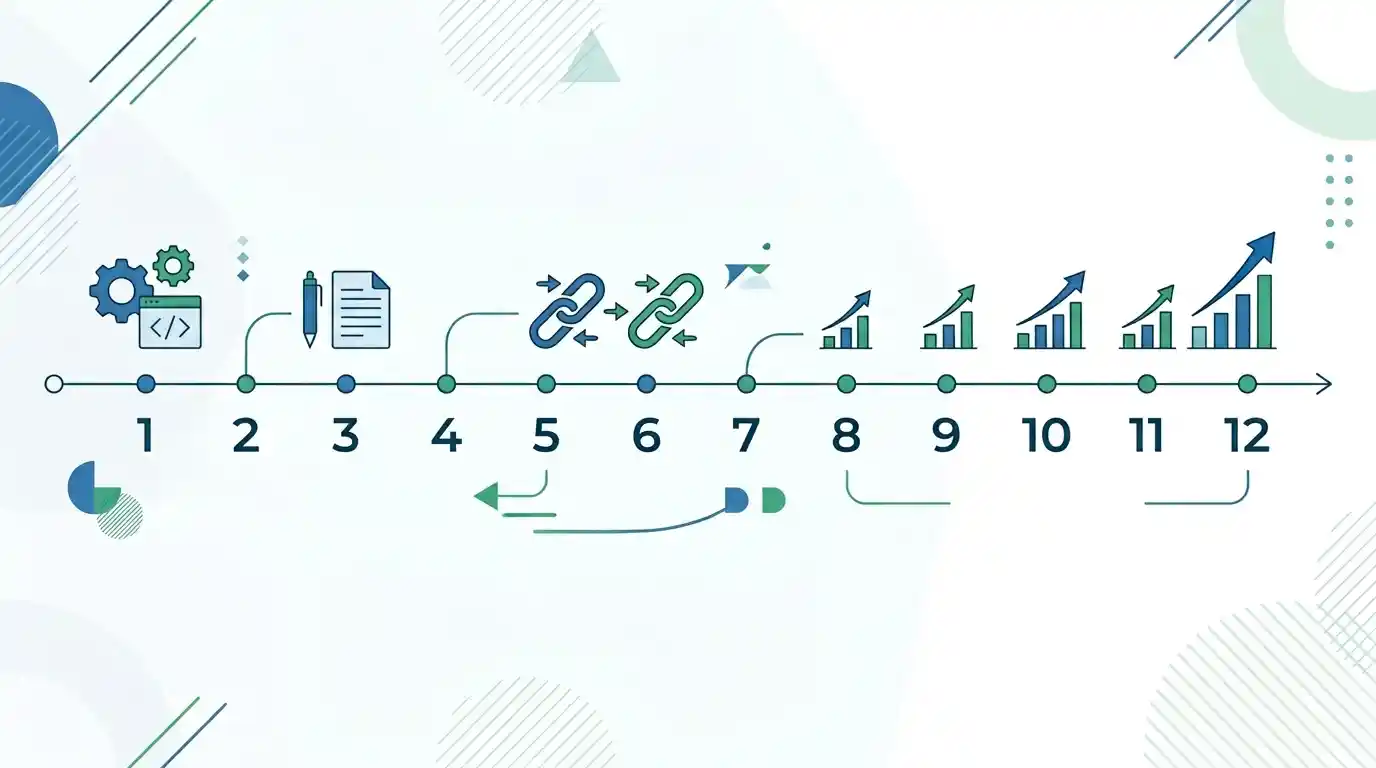
Everyone asks this question. Usually right after spending money on SEO for 6 weeks and wondering why Google hasn’t noticed yet.
The honest answer? SEO takes 3 to 12 months to show meaningful results, depending on your website, your competition, and what you’re actually doing. But that range is almost useless without context. So let’s break it down properly.
The real SEO timeline (month by month)
Here’s what actually happens when you start SEO from scratch:
Months 1–3: Foundation work, no visible results
This is where most people panic. Rankings barely move. Traffic looks flat. You’re doing technical SEO fixes, publishing content, building your site structure. Google is watching, crawling, making up its mind. Nothing dramatic shows up in your analytics yet.
But this phase matters more than people realize. If you skip it, everything that follows is built on sand.
Months 3–6: Early movement
This is when you start seeing it. A few keywords creep into the top 20. Organic traffic ticks up. Blog posts you wrote in month 1 start getting impressions in Google Search Console.
For low-competition keywords, you might hit page 1 here. Competitive ones? Still baking.
Months 6–12: Real traction
This is the inflection point. Backlinks you built earlier start compounding. Content builds topical authority. Rankings stabilize and climb. Organic traffic becomes something you can actually report to a client or boss.
According to Ahrefs, most websites start seeing noticeable SEO results between 3 to 6 months. New domains with no authority typically need 6 to 12 months. Google’s own former Developer Programs Tech Lead Maile Ohye said SEOs need “four months to a year” just to implement improvements and see early benefit.
Why SEO takes this long
Search engines don’t hand out rankings like candy. Google has to crawl your site, index your pages, evaluate your content quality, assess your backlink profile, compare you to every other page targeting the same keyword, and then decide where you rank.
That process takes time. Especially trust-building.
A new domain is essentially a stranger walking into a party. Google doesn’t know you yet. You have to earn your reputation through consistent quality content, backlinks from credible sources, good user experience signals, and time.
The main factors that affect your SEO timeline:
- Domain age and authority. An established site with existing backlinks ranks faster than a brand-new domain. Simple as that.
- Keyword difficulty. Low-competition keywords can rank in weeks. High-competition terms take months or years. Use tools like SEMrush, Ahrefs, or Ubersuggest to check keyword difficulty scores before targeting anything.
- Technical health. If Google can’t crawl and index your pages, you’re invisible. Core Web Vitals, page speed, and site structure all factor into crawlability and ranking signals.
- Content quality. Thin, generic content ranks slowly if at all. Content that matches search intent, demonstrates expertise, and gives users something genuinely useful moves faster.
- Backlinks. Links from authoritative sites tell Google other people vouch for you. Building a backlink profile takes months of outreach, content creation, and patience.
- Competition. A plumbing company in a small town ranks faster than a SaaS startup competing with $50M marketing budgets.
How long for different types of websites
New website with no history: 6–12 months minimum before meaningful organic traffic. No shortcuts here.
Established site with existing authority: 3–6 months to see improvements after optimization. Faster if technical issues were holding it back.
Local business SEO: Often 3–4 months for Google Maps visibility through your Google Business Profile. Faster than national SEO because you’re competing locally, not globally. If you run a local business, SEO for small businesses works differently from enterprise SEO.
E-commerce website: 6–12 months for competitive product pages. Faster for long-tail product queries with low competition.
Blog post targeting a long-tail keyword: Sometimes 4–8 weeks if the keyword is low competition and your domain has decent authority.
The pattern: lower competition plus stronger domain authority equals faster results. Every time.
SEO vs. Google Ads: the timeline difference
Paid search (Google Ads, PPC) can show results in 24 hours. You pay, your ad appears, traffic comes. Turn off the budget, traffic stops.
SEO takes months to build. But once rankings are established, organic traffic keeps coming whether you’re actively spending or not. It compounds over time in a way paid search never does.
That compounding effect is why SEO ROI often looks poor in month 3 and excellent in month 18.
If you need leads tomorrow, run ads. If you’re building something that should still be generating traffic in 3 years, invest in SEO. Ideally, do both.
Why your SEO isn’t working after 3 months
A few common culprits:
- Google hasn’t indexed your pages. Check Google Search Console. If pages aren’t indexed, nothing else matters.
- You’re targeting keywords that are too competitive. A new site can’t rank for “digital marketing” in 90 days. Start with proper keyword research targeting low-difficulty, high-intent terms first.
- Technical issues blocking crawlers. Broken links, slow load times, missing sitemaps, poor mobile experience. Run a full on-page SEO audit and fix what’s broken.
- Thin or duplicate content. Google doesn’t rank pages that don’t add something new. If your content is essentially a rewrite of the top 3 results, expect to stay buried.
- No backlinks. Content without links is a book nobody cites. You need external sites pointing to yours.
If you’ve checked all of this and still can’t figure out why your website isn’t ranking, there’s a deeper diagnosis required.
What SEO looks like in 2026
The game has shifted. Google now shows AI Overviews for roughly 55% of searches. Up to 58% of searches end without a click at all (zero-click searches).
This doesn’t mean SEO is dying. It means the definition of “results” has expanded.
Your content now needs to be optimized for:
- Traditional rankings (still matters, especially for clicks)
- Featured snippets (direct answers at the top of results)
- AI Overviews (Google’s AI summarizing answers from trusted sources)
- Google Business Profile for local searches
- Voice search responses
To show up in AI Overviews, your content needs clear, direct answers structured around real questions people ask. Short, factual sentences. Well-organized headers. E-E-A-T signals (Experience, Expertise, Authoritativeness, Trustworthiness) baked into the content itself.
Google’s Search Central documentation explains what actually moves rankings, and it’s not tricks. It’s creating helpful, reliable content for people.
How to speed up your SEO results (practically)
You can’t skip the timeline entirely. But you can work faster within it.
- Fix technical issues first. Crawlability issues are the fastest wins. If Google can’t read your pages, none of the content work matters.
- Target low-competition keywords early. Build domain authority on easier wins before going after hard keywords. Check our beginner’s guide to SEO for a solid starting framework.
- Publish content consistently. Google rewards sites that demonstrate consistent effort. One great article a month beats nothing. Weekly beats monthly.
- Build internal links. Connect your content. A well-linked site spreads authority across pages and helps Google understand your site structure.
- Get backlinks from relevant sites. Quality beats quantity. One link from a respected industry site is worth 50 from random directories.
- Monitor with Google Search Console. Watch impressions before clicks. Impressions rising means Google is seeing you, even if clicks haven’t followed yet. That’s early momentum.
Should you hire an SEO agency?
A good agency won’t promise page 1 in 30 days. Anyone who does is selling you something you don’t want to buy.
What a legitimate agency brings: faster execution, proven processes, tools that cost thousands per month individually (SEMrush, Ahrefs, Screaming Frog), and experience reading Google’s signals across many clients at once.
If you’re weighing this decision, how to choose the best digital marketing agency walks through what to actually look for. And what to expect when hiring for SEO covers the sales process so you don’t get oversold.
FAQ: How long does SEO take?
How long does SEO take for a brand new website? A new website typically needs 6 to 12 months before seeing significant organic traffic. The first 3 months focus on technical setup, indexing, and content creation. Results compound from there.
Does SEO work in 3 months? You can see early movement in 3 months, especially for low-competition keywords. But 3 months is usually too early to judge an SEO strategy’s full potential. Give it 6 months minimum before drawing conclusions.
Can SEO show results in 1 month? Occasionally, yes. Technical fixes like resolving crawl errors or removing a noindex tag can restore rankings quickly. A brand-new post targeting a zero-competition keyword on an established domain can rank within weeks. But these are exceptions, not the rule.
How long does it take for backlinks to affect SEO? Most SEOs report seeing backlink impact within 2 to 3 months after acquisition. Google needs time to crawl the linking page, pass authority, and reassess your rankings. High-authority links tend to move the needle faster.
How long does local SEO take? Local SEO through Google Business Profile often shows results in 3 to 4 months. Local pack rankings (the map results) are typically faster to achieve than organic blue-link results for competitive terms.
How do I know if my SEO is working? Watch Google Search Console for rising impressions first. Then clicks, then rankings. Organic traffic growth in Google Analytics confirms the trend. Month-over-month comparison over 6 months gives you a reliable read.
What is a realistic SEO timeline? For most businesses: visible early signals at 3 months, meaningful traffic growth at 6 months, strong ROI and competitive rankings by 12 months. Highly competitive markets take longer.
The short version
SEO takes 3 to 12 months depending on your site’s authority, competition level, technical health, and content quality. New sites take longer. Established sites with existing authority move faster. Local SEO is often faster than national campaigns.
Patience isn’t optional. The compounding nature of SEO means results build slowly then feel sudden, usually right around month 6 to 8.
If you want to shortcut the learning curve, the team at Flow Stack Hub specializes in exactly this. From technical audits to full content strategies, they handle the SEO groundwork while you run your business.
Book a seat at the advanced digital services offered by Flow Stack Hub and let professionals build a strategy around your actual timeline. Visit flowstackhub.com/services to see what’s available, or contact the team directly if you want to talk through your situation first.
Want to explore more? Check out the Flow Stack Hub blog for more guides on SEO, content strategy, and digital growth.

[…] how long SEO takes to show results matters here because E-E-A-T is a compounding investment. The authority you build over 12 months […]
[…] For context on how long the full SEO process takes, see our article on how long SEO takes to show results. […]
[…] For a broader look at ranking timelines, check out our guide on how long SEO actually takes to show results. […]
[…] We documented a full test in our 90-day SEO case study, and for a broader answer, our guide on how long SEO takes to show results sets realistic expectations. If you’re deciding between the major platforms, our comparison […]