


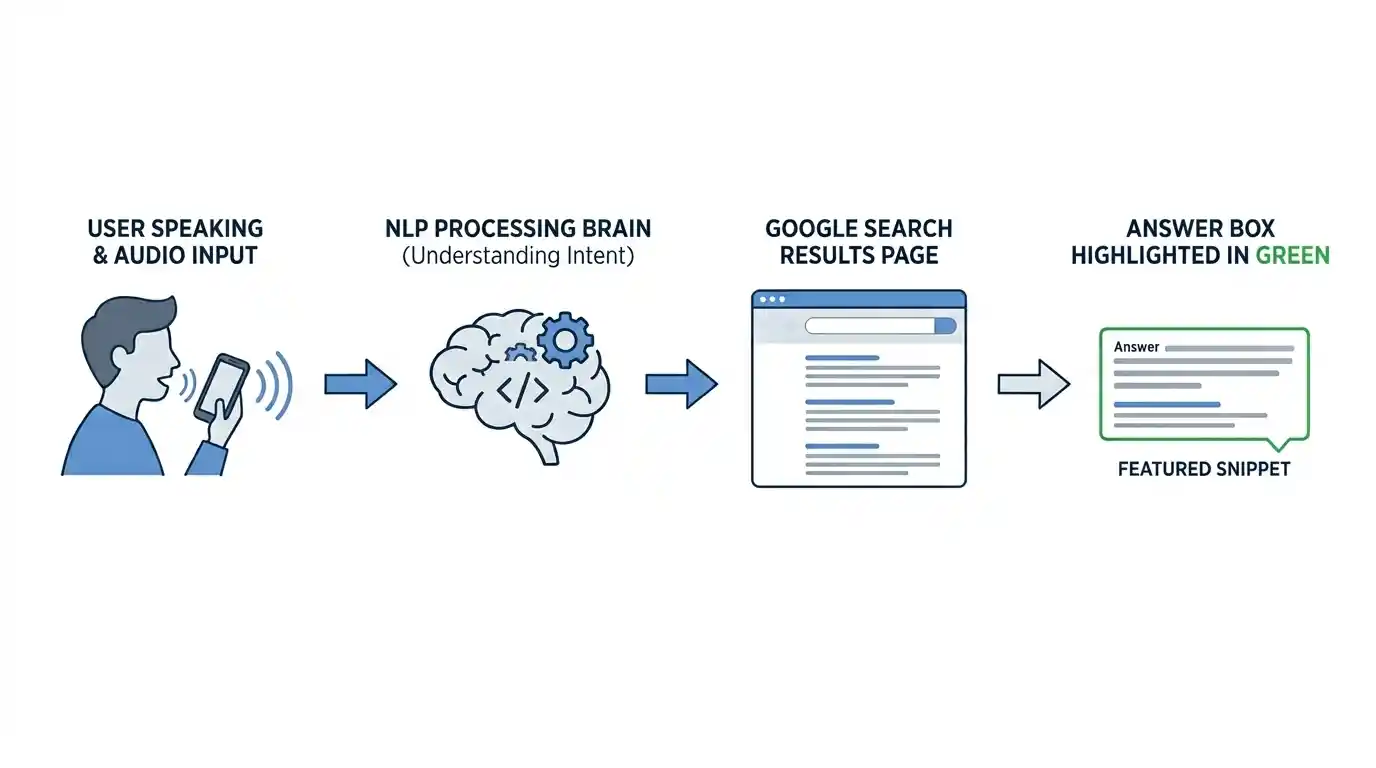
People aren’t typing as much anymore. They’re talking.
“Hey Google, best pizza place near me.” “Alexa, what’s the weather in Karachi?” “Siri, how do I fix my website’s Core Web Vitals?”
Voice search has been growing quietly for years, and by 2026 it’s not a trend worth watching. It’s a traffic channel worth owning. If your website isn’t set up for spoken queries, you’re missing a real slice of organic traffic, especially local and mobile searches.
This guide covers exactly how voice search SEO works, what Google actually looks for, and the specific changes you can make to start appearing in voice search results. No fluff.
What is voice search SEO?
Voice search SEO is the process of optimizing your website so it appears when people search using spoken language instead of typed text.
When someone asks Google Assistant, Amazon Alexa, Apple Siri, or a Google Home device a question out loud, Google pulls an answer from a webpage. That webpage almost always comes from position 1, a featured snippet, or a local pack result. Voice search SEO is about getting your content into those spots.
The core difference from regular SEO: voice queries are longer, more conversational, and almost always phrased as full questions. “Best SEO tips” becomes “What are the best SEO tips for a small business?” That shift in phrasing changes how you write content and which keywords you target.
If you’re new to SEO altogether, start with the complete beginner’s guide to SEO for 2026 before going deeper here.
How voice search actually works in 2026
Google processes voice queries through natural language processing (NLP). The BERT and MUM algorithms help Google understand the meaning behind a question, not just the words in it.
So when someone says “how do I get my new site to show up on Google faster,” Google doesn’t just match those words. It understands the intent: the person wants to know about indexing a new website.
The answer Google reads out loud comes from one of these sources:
- A featured snippet (position zero)
- A People Also Ask result
- A Google My Business listing (for local queries)
- A rich result from structured data
Your job is to be in one of those spots. The rest of this article tells you how.
Why voice search matters for your SEO strategy in 2026
Over 50% of smartphone users use voice search daily. Smart speaker ownership keeps climbing. And Google’s AI Overviews, which pull summarized answers directly into search results, follow the same logic as voice search: they look for clear, direct, authoritative answers.
So optimizing for voice search and optimizing for AI Overviews is essentially the same work.
For local businesses, the impact is even more direct. Searches like “SEO agency near me,” “best restaurant open now,” or “plumber in Lahore” are overwhelmingly voice-driven. If your Google My Business listing and local SEO aren’t dialed in, you’re invisible for those queries.
For small business owners especially, this is worth paying attention to. The SEO guide for small businesses goes deeper on this specific angle.
The biggest differences between voice search and text search
Query length. Typed searches average 2 to 3 words. Voice searches average 6 to 10 words. That’s a completely different keyword strategy.
Question format. Voice queries almost always start with who, what, where, when, why, or how. Your content needs to answer these directly.
Local intent. A high percentage of voice searches are local. “Near me” queries spike on mobile voice. If you run a local business and your site has no local SEO, voice search won’t help you at all.
Conversational tone. People talk to their devices like they talk to a person. Your content should match that register.
How to optimize your website for voice search in 2026
1. Target conversational, question-based keywords
Stop optimizing only for short-tail keywords. Voice search runs on long-tail conversational queries.
Instead of targeting “voice search SEO,” also target “how do I optimize my website for voice search” and “what is the best way to rank for voice search queries on Google.”
The easiest way to find these: Google’s “People Also Ask” box. Type your main topic, look at every question that appears, and write content that answers each one directly. Those questions are exactly what people are asking out loud.
For a full keyword research process, the keyword research pro guide for 2026 covers conversational keyword research in detail.
2. Win featured snippets (position zero)
Google reads featured snippets for roughly 40% to 60% of voice search answers. If your page is in a featured snippet, you’re the voice search answer for that query.
How to get featured snippets:
- Answer the question in the first 40 to 60 words after the H2 heading
- Use a clear question as your subheading
- Follow the answer with supporting detail
- Use numbered lists or bullet points for “how to” queries
- Use a short paragraph for definition or explanation queries
The structure Google wants is: question heading, direct answer, then context. Write every H2 section that way.
3. Add FAQ schema markup
This is the single biggest technical win for voice search SEO.
FAQ schema tells Google that your page contains question-and-answer pairs. Google can then pull those Q&A sets directly into search results as rich results, and voice assistants read them directly.
Add FAQ schema to every article that has a questions section. If you’re using Rank Math or Yoast SEO, both have built-in FAQ block options that generate the JSON-LD schema automatically.
For a full look at on-page SEO including schema setup, the on-page SEO checklist with 25 points for 2026 walks through every implementation step.
4. Fix your page speed
Google’s voice search algorithm heavily favors fast-loading pages. Most voice search answers come from pages that load in under 2 seconds.
Core Web Vitals, specifically LCP (Largest Contentful Paint), directly affect your chances of appearing in voice search results. A slow page won’t get picked as the voice answer, even if the content is perfect.
Check your scores in Google Search Console under Core Web Vitals. For a practical fix guide, see how to fix Core Web Vitals: LCP, FID, and CLS.
5. Optimize for local voice search
Most “near me” and location-based voice queries pull from Google My Business listings and locally optimized pages. If your business serves a specific area, do this:
- Claim and fully fill out your Google My Business profile
- Include your city and region naturally in page content
- Add local business schema markup (JSON-LD) to your homepage and contact page
- Get reviews. Google favors businesses with consistent, recent reviews for local voice results.
- Make sure your NAP (name, address, phone number) is consistent across every directory
For businesses in Pakistan, India, UAE, or any local market, this local layer is where most of the voice search opportunity actually sits.
6. Write in a conversational tone
Your content should sound like how a knowledgeable person explains something, not like a textbook or a keyword-stuffed SEO article from 2015.
Read your content out loud. If it sounds robotic, rewrite it. Voice search favors content that matches the natural register of spoken language. Short sentences. Direct answers. Plain words.
Google’s BERT algorithm was specifically built to understand conversational language. Content written conversationally performs better in both voice and standard search results.
7. Build topical authority on your subject
Google trusts sites that cover a topic in depth. If your site has 1 article on SEO, it’s a thin source. If it has 20 well-structured articles covering different aspects of SEO, Google sees topical authority and ranks your content more consistently across voice and text queries.
Build content clusters. Write a pillar page on your main topic, then write cluster articles covering specific sub-questions. Link them together internally. This is the content architecture that generates consistent voice search appearances.
The link building strategies for 2026 guide covers how authority flows across a site and how to build it methodically.
8. Make sure your site has HTTPS
Google has confirmed that HTTPS is a ranking signal, and voice search results come almost exclusively from secure sites. If your site still runs on HTTP, that’s an immediate fix needed before anything else.
Voice search SEO and Google AI Overviews: what’s the connection?
Google’s AI Overviews (previously called SGE) and voice search pull from the same content signals. Both look for:
- Direct, well-structured answers
- Pages with strong E-E-A-T signals
- Content with FAQ and structured data markup
- Fast, mobile-friendly pages
- Authoritative sites with topical depth
Optimizing for voice search and optimizing for AI Overviews is the same work. If your content starts appearing in AI Overviews, voice search results follow. The two systems feed from the same pool of trusted sources.
For a deeper look at E-E-A-T and how Google evaluates site authority, read the guide on E-E-A-T and Google website authority.
Tools to use for voice search optimization
You don’t need expensive software to start. Here’s what actually helps:
Google Search Console: Shows which queries your pages appear for, including long-tail question queries. Filter by question words (who, what, where, how) to find your voice search keyword opportunities.
AnswerThePublic: Free tool that maps out every question people ask around a topic. Perfect for building FAQ content.
Google’s People Also Ask: Free, directly in search results. The best source for real conversational queries.
Ahrefs or SEMrush: For keyword difficulty and search volume on longer conversational queries. For a comparison of which tool works best for different use cases, see SEMrush vs Ahrefs vs Ubersuggest.
Rank Math or Yoast SEO: For implementing FAQ schema and structured data without touching code.
Google’s own Search Central documentation has the official spec for FAQ schema if you want to implement it manually.
Common voice search SEO mistakes to avoid
Writing only for typed searches. If every piece of content targets 2-word keywords, you’re not set up for voice. Add conversational, question-based variations to your keyword strategy.
Skipping structured data. Content without schema markup is far less likely to be pulled as a voice search answer. FAQ schema takes 15 minutes to add and makes a measurable difference.
Ignoring mobile performance. Voice search is predominantly mobile. A site that loads in 5 seconds on mobile won’t win voice results regardless of content quality.
No local optimization. For any business with a physical presence or service area, skipping Google My Business and local schema leaves a lot of voice traffic on the table.
Writing like a textbook. If your content reads like a formal report, it won’t match the conversational tone of voice queries. Write like you’re explaining something to a person, not filing a document.
If your site has been stuck on page 2 or further back despite good content, the breakdown of why websites aren’t ranking in 2026 covers many of the same technical gaps that hurt voice search performance.
FAQ: voice search SEO
What is voice search SEO?
Voice search SEO is the process of optimizing website content to appear when people search using spoken language on devices like Google Assistant, Siri, or Alexa. It focuses on conversational keywords, featured snippets, FAQ schema, and local SEO signals.
How is voice search different from text search?
Voice queries are longer, phrased as full questions, and often have local intent. Text searches tend to be short and fragmented. Voice search requires content written in a conversational tone with direct, question-and-answer structure.
Does page speed affect voice search ranking?
Yes, directly. Google’s voice search algorithm strongly favors fast-loading pages. Pages with poor Core Web Vitals scores rarely appear as voice search answers. Aim for an LCP under 2.5 seconds.
What schema markup helps most with voice search?
FAQ schema (FAQPage) is the most impactful for voice search. It tells Google your page contains direct answers to specific questions. HowTo schema helps for step-by-step voice queries. Both are supported in Rank Math and Yoast SEO.
How do I rank for “near me” voice searches?
Optimize your Google My Business listing completely, add local business schema to your site, include your location naturally in page content, and build consistent citations across local directories. Reviews also directly impact local voice search visibility.
Can a small business compete in voice search?
Yes, and local businesses actually have an advantage. Voice searches for local services (“accountant near me,” “web agency in Islamabad”) pull from local results where a well-optimized small business can beat large national sites. Local SEO levels the playing field.
Final word
Voice search won’t replace text search. But it’s already a significant, measurable traffic source and it’s growing.
The technical work is the same SEO you should already be doing: fast pages, strong content, proper schema, local optimization, and topical authority. Voice search just rewards these things more visibly.
Start with FAQ schema and question-based content. Fix your Core Web Vitals. Fill out your Google My Business. Those 3 moves alone will get you further than most websites that ignore voice entirely.
And if you want a team that handles all of this end to end, the digital marketing and SEO services at Flow Stack Hub cover everything from technical SEO to full content strategy. You can also see the portfolio or get in touch directly to talk through what your site specifically needs.
The traffic is there. Voice search is just a different door into it.


[…] continues shifting toward AI-assisted discovery. It’s worth pairing this work with a look at voice search optimization too, since both trends are part of the same shift toward more conversational, AI-driven search […]
[…] play a bigger role in the next few years. If you want to get ahead of that shift now, our guide to optimizing for voice search in 2026 is a good place to […]